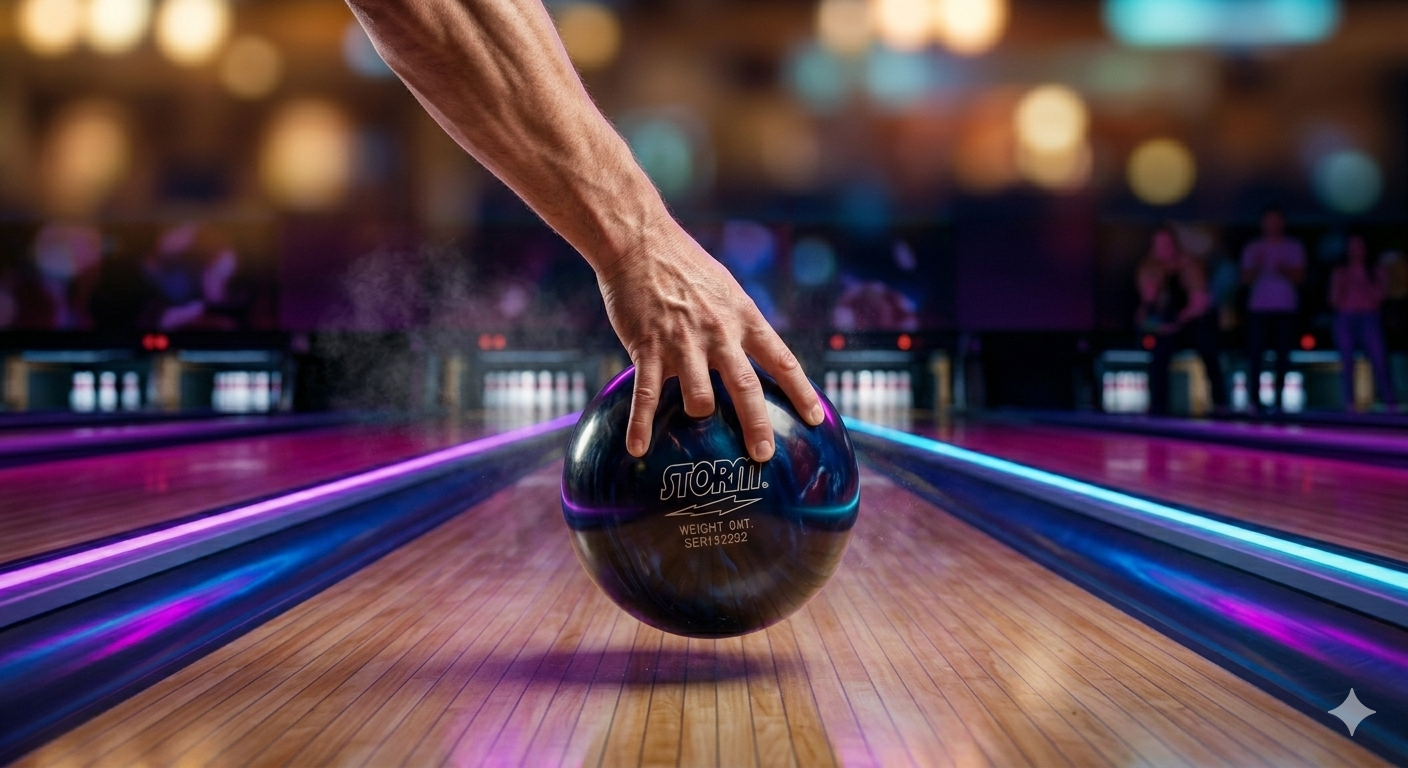

Hooking a bowling ball requires keeping your hand behind the ball during the downswing, then rotating your fingers from approximately 4 o'clock to 7 o'clock position (for right-handers) at release while your thumb exits first. This finger rotation creates axis tilt and revolutions that cause the ball to curve toward the pocket as it transitions from the oily front part of the lane to the drier backend area. The hook's effectiveness depends on proper timing where your thumb releases cleanly before your fingers lift and rotate, combined with appropriate ball selection that matches your rev rate and ball speed. Mastering hook technique increases strike percentage, provides better entry angles into the pocket, and allows adjustment capabilities for varying lane conditions that straight bowling cannot achieve.
A bowling ball hooks due to the combination of rotation (revolutions) and lane friction working together. Modern reactive resin bowling balls feature coverstock materials that grip lane surfaces when they encounter friction, allowing the ball's rotation to change its direction. On fresh oil patterns, balls skid through the front part of the lane with minimal direction change. As balls reach the drier backend area with less oil, increased friction allows the coverstock to grip, causing the ball to hook sharply toward the pins.
The amount of hook depends on three primary factors: rev rate (how fast the ball rotates), ball speed, and equipment characteristics. Higher rev rates create more hook potential, while faster ball speeds reduce hook by limiting friction time. The ball's coverstock aggressiveness and core design significantly impact hook potential—aggressive reactive resin balls hook more than polished or plastic balls. Understanding bowling ball types helps bowlers select equipment matching their physical game and desired ball motion.
Professional bowlers in Storm bowling jerseys generate 300-500 RPM creating dramatic hooks, while recreational bowlers typically produce 200-300 RPM with moderate hook. The hook's strategic advantage involves entering the pocket at sharper angles that create better pin carry compared to straight balls hitting head-on. Equipment like the Storm Phaze AI bowling jersey represents aggressive technology designed for maximum hook potential.
|
Hook Factor |
Impact on Ball Motion |
Beginner Range |
Advanced Range |
|
Rev rate (RPM) |
More revs = more hook |
200-300 RPM |
400-500+ RPM |
|
Ball speed |
Faster = less hook |
14-16 mph |
17-19 mph |
|
Axis rotation |
More rotation = more hook |
30-45 degrees |
45-60 degrees |
|
Coverstock |
Aggressive = more hook |
Urethane/weak reactive |
Strong reactive resin |
Using a fingertip grip rather than conventional grip provides the leverage necessary for generating rotation. Fingertip grips insert fingers only to the first knuckle, allowing greater finger action at release compared to conventional grips where fingers insert to the second knuckle. This reduced insertion lets your fingers stay in the ball longer during release, creating more lift and rotation as they exit.
The grip should feel secure but not overly tight—tension in your hand restricts the fluid motion necessary for rotation. Your thumb should exit the ball cleanly without hanging or sticking, which prevents proper finger action. Many bowlers use thumb tape or switch thumb slugs to ensure consistent, clean thumb exits that enable maximum finger rotation.
Wrist position during the approach affects hook potential. Maintain a relatively firm wrist with slight cup throughout your swing, avoiding excessive breaking or cupping that reduces leverage. A firm wrist position at release transfers energy into rotation efficiently. Some bowlers use wrist supports to maintain proper wrist angle, providing stability that allows consistent finger rotation. Competitive players wearing Hammer bowling jerseys often use wrist devices to optimize their release mechanics. Equipment like the Hammer Black Widow Mania bowling jersey pairs with proper wrist mechanics for maximum hook generation.
Keep your hand behind and slightly to the side of the ball throughout your downswing—imagine maintaining a handshake position as the ball swings forward. This position prevents premature rotation that dissipates energy before release. Your hand should stay in this position until your thumb exits, then your fingers naturally rotate around the ball's side.
Avoid turning your hand too far around the ball's side during the downswing. This common mistake creates excessive axis rotation that reduces hitting power and makes timing inconsistent. The proper position keeps your hand mostly behind the ball with minimal side rotation until the actual release moment. Your elbow should track close to your body during the downswing, creating a compact swing plane that promotes consistent hand position.
Many bowlers rotate too early, essentially throwing a spiral during the entire swing rather than concentrating rotation at release. This error reduces hook effectiveness despite increased effort. The key involves patience—maintain your hand position throughout the swing, then allow natural rotation to occur as your fingers exit.
The release sequence determines how effectively you transfer rotation to the ball. Your thumb must exit first, creating the brief moment where your fingers can generate rotation independently. As the thumb exits cleanly, your fingers remain in the ball momentarily, allowing them to lift and rotate around the ball's equator. This sequential exit—thumb then fingers—creates the leverage necessary for high rev rates.
During finger exit, rotate your hand from approximately 4-5 o'clock to 7-8 o'clock position (for right-handers), creating both axis rotation and axis tilt. This rotation occurs naturally through finger lifting motion rather than forced hand turning. The sensation should feel like you're shaking hands with someone as you release—a natural, fluid motion rather than a deliberate twist.
The amount of finger lift affects rev rate and axis tilt simultaneously. More aggressive finger lift creates higher revolutions but may sacrifice control. Start with moderate lift that balances revolutions with accuracy, gradually increasing lift as your timing and control develop. Professional bowlers in Motiv bowling jerseys demonstrate natural rotation patterns that generate maximum revolutions with minimal forced motion. Equipment like the Motiv Jackal Onyx bowling jersey responds aggressively to proper release mechanics.
|
Release Component |
Timing |
Action |
Purpose |
|
Thumb exit |
First |
Clean, early release |
Create finger leverage |
|
Finger hold |
Brief moment |
Stay in ball |
Build rotation potential |
|
Finger lift |
Immediately after thumb |
Upward motion |
Generate revolutions |
|
Hand rotation |
During finger exit |
4 o'clock to 7 o'clock |
Create axis tilt |
Start by practicing your release motion without a ball, focusing on thumb-out-first followed by finger rotation. Stand in release position and repeatedly practice this sequence until the motion feels natural and automatic. This shadow practice builds muscle memory without the complexity of controlling a 15-pound ball.
Progress to one-step drills where you take a single step and release the ball, focusing entirely on hand position and rotation rather than approach mechanics. This simplified drill isolates the release, allowing you to feel proper thumb exit followed by finger rotation. Use a lighter ball (12-13 pounds) initially to reduce grip demands while learning rotation mechanics. Understanding how to add spin provides detailed rotation technique breakdowns.
Advance to full approaches once one-step releases produce consistent rotation. Start with moderate hook attempts—don't try to generate maximum hook immediately. Gradually increase finger lift and rotation as your timing and control improve. Video analysis from the side angle reveals whether your hand position and rotation match your intentions, identifying unconscious adjustments or errors.

Gripping too tightly prevents the natural rotation necessary for hooking. Tension in your hand and forearm restricts fluid motion that generates revolutions. Stay relaxed throughout your approach, allowing your hand to remain loose enough for natural rotation when the thumb exits. The effort should feel efficient rather than forced.
Coming around the side of the ball excessively creates too much axis rotation that reduces hitting power. While side rotation is necessary for hook, too much causes the ball to deflect off the headpin rather than driving through the pocket effectively. Balance rotation with enough forward roll to maintain proper pin carry. Professional bowlers wearing Roto Grip bowling jerseys master this balance between rotation and forward roll. Equipment like the Roto Grip Optimum Idol bowling jersey requires proper release balance to perform optimally.
Rotating too early during the downswing dissipates rotational energy before release, reducing final rev rate despite increased effort. The rotation should concentrate in the final fraction of a second as your fingers exit, not gradually throughout the entire swing. Players in 900 Global bowling jerseys emphasize release timing precision. Technology like the 900 Global Zen 25 bowling jersey amplifies proper timing through aggressive ball reaction.
Fresh oil patterns require more aggressive hooks to generate adequate ball motion through dense oil. Increase your rev rate through more aggressive finger lift, or select more aggressive ball surfaces that create friction despite oil volume. Broken-down conditions with depleted oil require reduced hook to prevent over-reaction. Decrease finger lift slightly, increase ball speed, or move to less aggressive ball surfaces.
Different oil patterns require different hook strategies—house shots with heavy middle oil forgive aggressive hooks, while sport patterns with flatter oil distribution demand precise hook control. The ability to increase or decrease hook on demand provides versatility separating elite bowlers from good ones. Tournament players in Brunswick bowling jerseys develop multiple release variations for pattern-specific applications. Equipment like the Brunswick Hypnoize bowling jersey handles varying hook requirements through versatile ball motion characteristics.
Ball selection dramatically impacts hook potential. Aggressive reactive resin balls with rough surfaces create maximum hook, while polished balls or plastic spare balls hook minimally. Beginners should start with entry-level reactive balls that provide moderate hook without excessive sensitivity.
Ball drilling layouts affect hook characteristics significantly. Pin-up layouts create earlier hook and more overall board coverage, while pin-down layouts delay hook and create sharper backend reactions. Work with your pro shop operator to select layouts matching your physical game and desired ball motion.
Ball maintenance affects hook consistency. Clean your ball after every session to remove absorbed oil that reduces friction and hook. Resurface balls periodically to restore factory characteristics that generate optimal motion. Professional players wearing Radical bowling jerseys, Track bowling jerseys, or DV8 bowling jerseys maintain strict ball maintenance schedules ensuring consistent hook performance.
Learning how to hook a bowling ball requires mastering proper hand position behind the ball during the downswing, clean thumb-out-first release sequencing, and controlled finger rotation from 4 o'clock to 7 o'clock at the release point. This technique generates revolutions that create hook motion as the ball transitions from oily front lanes to drier backend areas, providing strategic advantages through improved pocket entry angles and pin carry. Progressive practice starting with shadow releases, advancing through one-step drills, and finally integrating proper rotation into full approaches builds the muscle memory and timing necessary for consistent hooking. By avoiding common mistakes like early rotation and excessive side turn while matching your hook to appropriate equipment and lane conditions, bowlers develop the versatile shot-making capabilities that separate recreational players from competitive performers. Visit EFX to discover premium bowling apparel that supports your hook development while keeping you looking professional on the lanes.
Bowling Biomechanics Institute. (2024). Release mechanics and rotation generation techniques. BBI Technical Journal, 19(1), 67-84.
Professional Bowlers Association. (2024). Hook development and ball motion fundamentals. PBA Coaching Manual, 10th Edition, 34-58.
Strickland, R. (2023). Axis rotation, axis tilt, and their impact on ball motion. Journal of Bowling Science, 31(3), 112-129.
United States Bowling Congress. (2024). Release fundamentals for developing bowlers. USBC Coaching Resources, Section 4.
