
May 27, 2026 8 min read
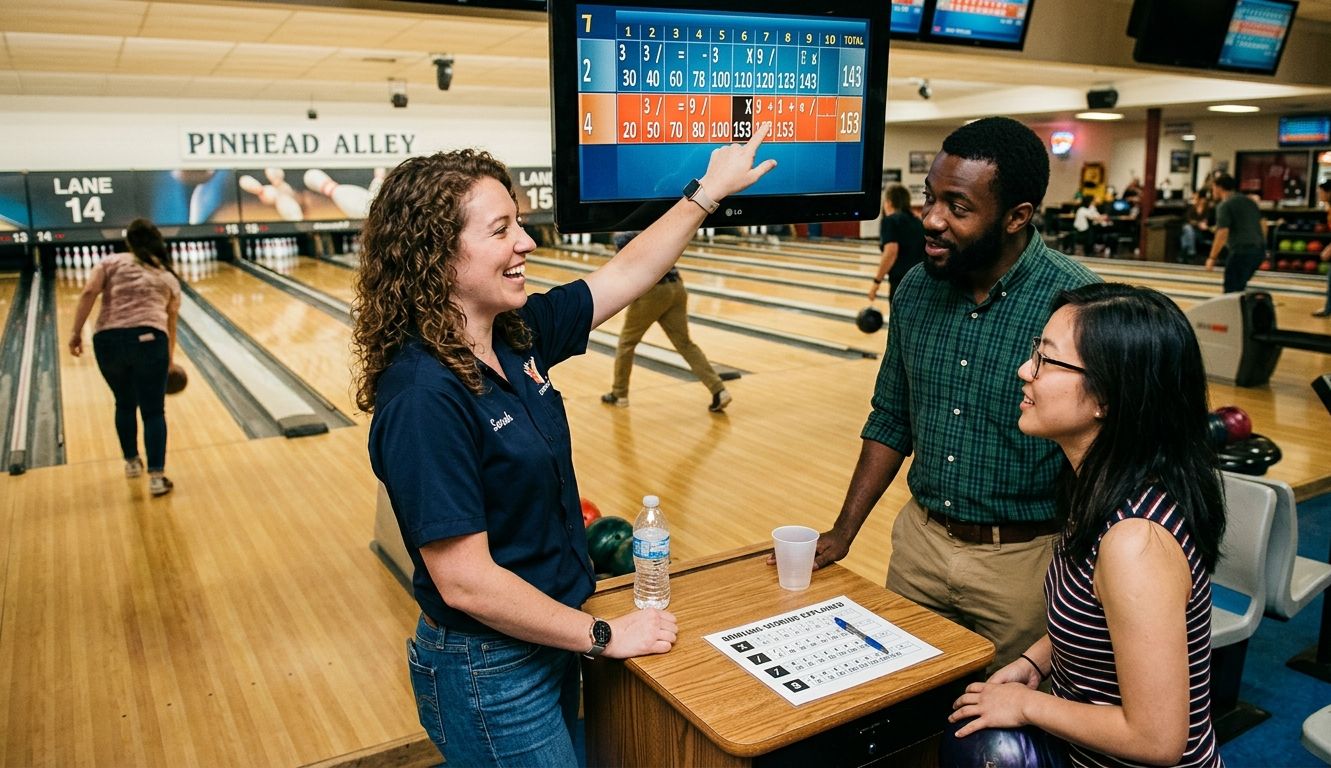
You just bowled what looked like a great game, but the scoreboard is showing numbers that make no sense. Sound familiar? Bowling scoring confuses almost every new player because the system rewards future rolls, not just the pins you knock down right now. This guide breaks down exactly how bowling scoring works, with real examples and a full scorecard walkthrough so nothing gets lost in translation.
Bowling scoring works on a bonus system across 10 frames. A standard game consists of 10 frames. In each of the first nine frames, you get up to two balls to knock down all 10 pins. The score for most frames is simply the number of pins knocked down, but strikes and spares trigger bonus points from your next deliveries. The maximum possible score is 300, achieved by bowling 12 consecutive strikes.
That last number surprises most beginners. With only 10 frames and 10 pins, why is the max 300 instead of 100? The answer lies in the bonus system, which we will get to shortly.
A frame is one scoring unit in a bowling game. Think of it like an inning in baseball. In frames 1 through 9, each frame gives you up to two deliveries to knock down all 10 pins. If you knock all 10 on your first ball, that is a strike and the frame is over. If you need both balls, that is either a spare or an open frame. Frame 10 has its own special rules covered in a later section.
|
Frame |
Balls Available |
When Frame Ends |
|---|---|---|
|
Frames 1 to 9 |
Up to 2 |
After strike (1 ball) or after 2 balls |
|
Frame 10 |
Up to 3 |
After 2 balls (open) or after 3 balls (strike or spare) |
The 10th frame allows extra balls specifically so strikes and spares in that frame can still collect their full bonus.
An open frame is any frame where you fail to knock down all 10 pins across both deliveries. It earns no bonus. Your score for that frame is simply the total number of pins knocked down. Bowl a 6 on the first ball and a 2 on the second, and that frame scores 8. Open frames are the biggest score leak for most casual bowlers, which is why spare conversion is one of the most important skills to develop.

Bowling scoring for a spare is more rewarding than it first appears. A spare is marked with a forward slash (/) on the scorecard and earns a bonus from the very next delivery you throw.
A spare scores 10 points plus the number of pins knocked down on your first ball of the next frame. Because the spare bonus depends on your next shot, you cannot finalize a spare frame's score until you bowl again.
You bowl a spare in frame 3. Your first ball in frame 4 knocks down 7 pins. Frame 3 scores 10 + 7 = 17. The 7 pins you knocked down in frame 4 are counted once as frame 3's bonus, and again as part of frame 4's own score.
|
Situation |
Frame Score |
Notes |
|---|---|---|
|
Spare, next ball = 3 |
13 |
Low follow-through |
|
Spare, next ball = 7 |
17 |
Solid conversion |
|
Spare, next ball = strike (10) |
20 |
Best possible spare frame |
A spare followed by a strike produces the maximum spare frame score of 20 points, which is why spares before strikes feel so satisfying on the scorecard.
See more: What Is a Spare in Bowling
A strike is marked with an X on the scorecard and is the most powerful shot in bowling. It earns a bonus from your next two deliveries, not just the next one. This is what makes consecutive strikes so valuable and why the maximum score is 300, not 100.
A strike scores 10 points plus the total number of pins knocked down on your next two balls. Because the bonus depends on two future deliveries, you cannot finalize a strike frame's score until you have bowled twice more.
When you bowl strikes in back-to-back frames, each strike feeds bonus points into the one before it. Two consecutive strikes are called a double. Three in a row is a turkey. The more strikes you chain together, the more each individual strike is worth, because every subsequent strike counts as both a standalone frame and a bonus for the previous frame.
|
Strike Sequence |
Name |
First Strike Worth |
|---|---|---|
|
Strike, then 7 + 2 |
Single strike |
10 + 7 + 2 = 19 |
|
Strike, strike, then 8 |
Double |
10 + 10 + 8 = 28 |
|
Strike, strike, strike |
Turkey |
10 + 10 + 10 = 30 (maximum) |
|
Four strikes in a row |
Four-bagger / Hambone |
First strike = 30; chain continues |
Three consecutive strikes (turkey) produces the maximum possible score for any single frame: 30 points. That is also why a game of 12 straight strikes scores exactly 300, since every frame reaches its ceiling of 30.
See more: What Is a Turkey in Bowling: Meaning, History and Scoring Explained
The 10th frame is where bowling scoring rules diverge from everything before it. Most beginners find this frame the most confusing, but it exists for a logical reason: to give strikes and spares in the final frame the same opportunity to collect their full bonus.
In frames 1 through 9, a strike earns bonus points from the next two balls, which come from the following frame. If the 10th frame worked the same way and you bowled a strike, there would be no following frame to supply those bonus balls. The game would shortchange you. To solve this, the 10th frame allows extra deliveries called fill balls, which exist purely to complete the bonus calculation.
The scoring in the 10th frame depends entirely on what you bowl in your first two deliveries.
|
10th Frame Result |
Total Balls in 10th |
How It Scores |
|---|---|---|
|
Strike on ball 1 |
3 balls total |
10 + next 2 balls (fill balls) |
|
Spare across balls 1 and 2 |
3 balls total |
10 + next 1 ball (fill ball) |
|
Open frame (no strike or spare) |
2 balls only |
Pins knocked down only; no bonus |
The fill balls are not a new frame. They are simply the mechanism that lets the 10th frame honor the same bonus rules as every other frame in the game. If you bowl three strikes in the 10th, you score 30 for the frame, same as a turkey anywhere else in the game.
For a full breakdown of maximum score calculations, the USBC confirms that 12 consecutive strikes across all frames, including three strikes in the 10th, produces a total of 300 points.

Seeing the numbers work in real time is the fastest way to understand bowling scoring rules. Below is a sample game scored frame by frame, starting from zero and building to a final total.
The bowler in this example mixes open frames, spares, and strikes across all 10 frames, which represents a typical recreational game rather than a perfect one.
|
Frame |
Ball 1 |
Ball 2 |
Ball 3 |
Frame Result |
Frame Score |
Running Total |
|---|---|---|---|---|---|---|
|
1 |
7 |
2 |
- |
Open |
9 |
9 |
|
2 |
8 |
/ |
- |
Spare |
10 + 6 = 16 |
25 |
|
3 |
6 |
3 |
- |
Open |
9 |
34 |
|
4 |
X |
- |
- |
Strike |
10 + 7 + 1 = 18 |
52 |
|
5 |
7 |
1 |
- |
Open |
8 |
60 |
|
6 |
X |
- |
- |
Strike |
10 + 10 + 3 = 23 |
83 |
|
7 |
X |
- |
- |
Strike (Double) |
10 + 3 + 6 = 19 |
102 |
|
8 |
3 |
6 |
- |
Open |
9 |
111 |
|
9 |
9 |
/ |
- |
Spare |
10 + 7 = 17 |
128 |
|
10 |
7 |
2 |
- |
Open |
9 |
137 |
Frame 4's strike score of 18 is calculated using the 7 and 1 bowled in frame 5. Frame 6's strike score of 23 uses the strike in frame 7 (10 points) plus the 3 bowled in frame 8. This is the cascading bonus logic that makes bowling scoring feel complex but rewards consistent play so powerfully.
Once you understand the bowling scoring system, a natural follow-up question is: what score should you be aiming for? The answer depends heavily on your experience level and whether you are playing casually or competitively.
|
Skill Level |
Typical Score Range |
Key Characteristic |
|---|---|---|
|
Complete beginner |
50 to 90 |
Mostly open frames |
|
Casual recreational |
90 to 130 |
Occasional spares |
|
Developing bowler |
130 to 170 |
Regular spare conversion |
|
Intermediate league |
170 to 200 |
Consistent spares, some strikes |
|
Advanced / competitive |
200 to 230 |
Strike rate above 50% |
|
Professional (PBA) |
220 to 250+ |
High strike and spare rates |
Most recreational bowlers average somewhere between 100 and 150. Crossing the 200 mark consistently requires a reliable strike ball and a strong spare conversion rate on single-pin leaves.
For a detailed look at score ranges and what they mean for different age groups and skill levels, see What Is a Good Bowling Score.
A single spare in an otherwise open-frame game might add 5 to 7 points above what you would have scored otherwise. A single strike adds more, but it is consecutive strikes that produce dramatic score jumps. Two strikes in a row adds roughly 20 to 25 points to a frame that would otherwise be worth 10. A turkey can add 30 points to a single frame, the equivalent of what most open-frame games earn across three full frames.
This is why league players focus heavily on strike percentage. Every additional strike in a sequence multiplies the value of the ones before it.
Recreational scoring and league scoring follow the same fundamental rules, but league play adds one layer most casual bowlers have never encountered: handicap scoring.
Handicap is a calculated adjustment that levels the playing field between bowlers of different skill levels. It is calculated by taking the difference between a bowler's average and a base score (usually 200 or 210), then multiplying by a percentage (commonly 80 or 90 percent). That result is added to the bowler's actual pin count each session.
For example, a bowler with a 140 average competing in a league using a 200 base and 90 percent formula would receive a handicap of (200 - 140) x 0.9 = 54 pins per game. This allows them to compete fairly against a 190-average bowler without either side being hopelessly outmatched.
See more: What Is a Handicap in Bowling: How to Calculate Bowling Handicap
In league bowling, your average is tracked across every session of the season and used to calculate handicap, determine team standings, and set seeding for end-of-season tournaments. Bowlers who improve their average during the season see their handicap adjusted accordingly, keeping competition balanced as skill levels evolve.
League play also introduces the social and visual side of the sport. Teams that compete together week after week often invest in custom bowling jerseys to build identity and professionalism on the lanes. A team that looks unified tends to bowl like one.
Bowling scoring rewards consistency over luck. Open frames cost you points, spares keep you in the game, and consecutive strikes are where scores climb fast. Once you understand how bonuses stack across frames, the scorecard stops being confusing and starts being strategic. Ready to look as good as you score? Browse our full range of bowling jerseys and team apparel built for league play.