
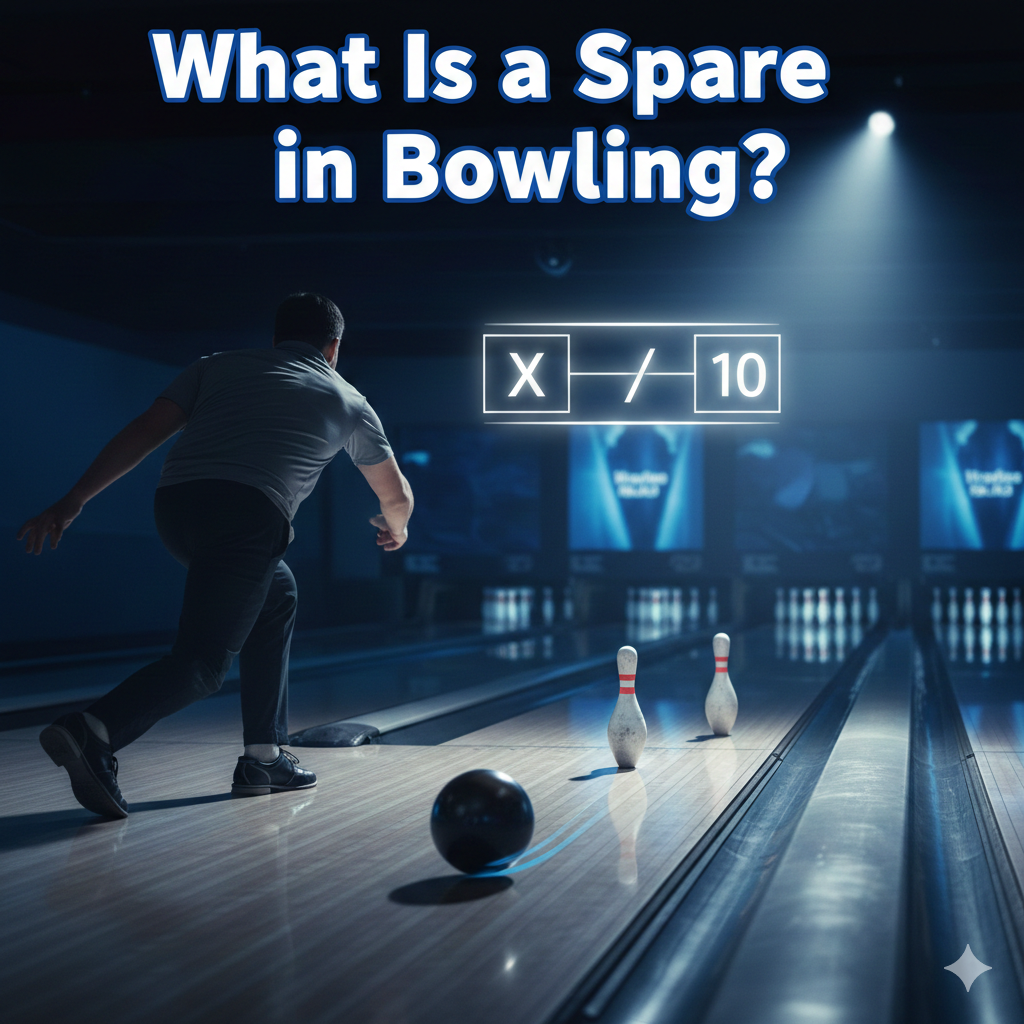

A spare is a scoring result in bowling where a player knocks down all ten pins using two shots in a single frame. This outcome reflects precision, adjustment, and the ability to recover after a non-strike first roll. The term appears constantly in scoring discussions because it influences both pin count and game momentum.
How a Spare Works in Bowling Scoring
A spare adds the pins from the next shot to the 10 pins already scored in the frame. This scoring rule, defined in the USBC scoring system, ensures that spare accuracy affects both the current frame and the upcoming roll. Because the value of a spare depends entirely on the next ball, bowlers treat spare conversion as a technical measurement of consistency.
Scoring breakdown:
- 10 pins + value of the next first roll
- Spare fills the frame but influences the next frame’s score
- Higher-value follow-up shots increase scoring pace
Mini examples:
- Frame 3: spare; next roll = 7 → total = 17
- Frame 6: spare; next roll = 9 → total = 19
- Frame 2: spare; next roll = 4 → total = 14
Because spares reliably add scoring stability, bowlers with strong spare conversion rates maintain higher game averages and reduce volatility across a match.

How a Spare Works in Bowling Scoring
What a Spare Symbol Looks Like on a Score Sheet
A spare is marked with a “/” on a bowling score sheet. The symbol appears in the box of the frame’s second roll, indicating that all remaining pins were cleared on that attempt. Each spare symbol represents a successful two-shot frame completion.
Common examples include:
- “9/” — first roll knocks down 9, second roll picks up the remaining pin
- “- /” — first roll hits zero pins (dash), second roll finishes the frame
- “0/” — identical to “- /” but explicitly shows a zero instead of a dash
The dash (-) indicates no pins contacted, while zero (0) explicitly shows a cleared lane hit with zero pinfall. A blank box means the roll has not occurred yet. Spare notation appears consistently across both recreational leagues and competitive play, often seen on team uniforms such as EFX Bowling Jerseys, which reflect scoring culture and identity.
Common Types of Spares
The following are the primary types of spares that describe how the pins remain standing after the first roll.
Single-Pin Spare
A single-pin spare involves clearing just one remaining pin after the first roll. Common leaves include the 10-pin, 7-pin, and 6-pin. These spares require exact alignment and a straight release. Bowlers typically use a plastic spare ball to reduce hook and target the pin directly. Because corner pins such as the 10-pin demand cleaner angles, accuracy defines success.
Multi-Pin Spare
A multi-pin spare leaves two or more pins after the first roll. Examples after plural nouns include the 2–4–5, 3–6, or 2–8 combinations. Bowlers must control ball deflection and select angles that allow the ball to drive consistently through the pin group. Multi-pin spares test understanding of entry lines and board targeting.
Washouts
A washout is a non-split spare where the headpin is missing after the first roll. Examples include the 1–2–10 and 1–2–4–10 leaves. Washouts are more difficult than standard multi-pin spares because the missing headpin creates an indirect angle to the remaining pins. The bowler must strike the correct side of the front-most remaining pin to complete the spare.
Splits (Spare Attempts)
Splits are spare attempts where two or more pins stand separated by a space the ball cannot pass through directly. Examples include the 7–10, 4–6, and 3–10. Splits are challenging because they require extreme pin deflection rather than straightforward ball impact. While splits do not guarantee spare conversion, they count as spare attempts on the score sheet.

Common Types of Spares
Spare vs. Strike: What Is the Difference?
A strike occurs when all ten pins fall on the first roll of the frame, while a spare results from knocking down all ten using two rolls. This difference affects scoring momentum, strategic rhythm, and frame-by-frame pressure. Strikes accelerate scoring pace through the double-bonus system, while spares stabilize score progression.
Comparison Table
| Result | Rolls Used | Scoring Formula | Symbol | Impact |
|---|---|---|---|---|
| Strike | 1 | 10 + next two rolls | X | Highest scoring momentum |
| Spare | 2 | 10 + next one roll | / | Consistent scoring progression |
| Open Frame | 2 | Sum of knocked pins | — | Decreases overall average |
| Split | 2 | Depends on spare conversion | ▲ or S | High difficulty situation |
| Foul | 1 or 2 | Roll counts as zero | F | Immediate scoring loss |
Spares maintain scoring consistency by preventing open frames and stabilizing a bowler’s average across multiple games.
Why Spares Are Crucial for High Bowling Scores
Spare conversion rate predicts scoring average more than strike percentage for most bowlers. Strikes build rapid momentum, but consistent spare shooting controls long-term performance.
Numerical relationships include:
- A bowler converting 70% of spares typically averages 150–170.
- A bowler converting 80% or more often reaches 180–200 averages.
- A bowler below 60% usually remains under 150, even with moderate strike rates.
In handicap leagues and competitive formats, players with stable spare control outperform high-strike competitors who leave frequent open frames. Reliable spare shooting reflects technical confidence, alignment discipline, and repeatable form—traits often emphasized in performance-focused apparel lines like Hammer Bowling Jerseys, where design and identity reinforce player consistency.
Techniques Bowlers Use to Convert Spares
Use a plastic spare ball for a straighter entry. Plastic creates minimal friction, preventing hook and allowing direct targeting, especially on corner pins.
Align your feet and target based on the remaining pin number. For example, bowlers adjust alignment left or right for pins such as the 2-pin, 3-pin, or 6-pin to ensure straight angles.
Control ball speed to reduce variation. Faster shots straighten the path, while slower shots introduce unwanted hook.
Adjust angles for corner pins such as the 7-pin and 10-pin. These require precise board targeting and slight alignment shifts to ensure the ball travels directly toward the pin.
Focus on hitting the pin itself rather than the pocket. Spares are robotic tasks, and visual narrowing increases accuracy.
These techniques help players convert everything from single pins to complex multi-pin leaves, contributing to consistent scoring performance.
Examples of Spare Situations (With Scoring Breakdown)
- 9/ then next roll = 8
- Pins knocked down: 9 first roll, 1 second roll
- Scoring formula: 10 + 8
- Total for the frame: 18
- 7/ then next roll = strike
- Pins knocked down: 7 first roll, 3 second roll
- Scoring formula: 10 + 10
- Total for the frame: 20
- -/ then next roll = 5
- Pins knocked down: 0 first roll, remaining pins second roll
- Scoring formula: 10 + 5
- Total for the frame: 15
- 0/ then next roll = 9
- Pins knocked down: 0 first roll, remaining pins second roll
- Scoring formula: 10 + 9
- Total for the frame: 19
These examples show how the next roll directly determines a spare’s total value.
How Spares Influence Bowling Strategy for Beginners and Advanced Players
Beginners benefit from learning to shoot straight at remaining pins, prioritizing strong mechanics and reduced hook. Simpler angles help them avoid open frames. Intermediate players focus on oil patterns, deflection behavior, and why certain leaves appear. Advanced bowlers refine conversion of challenging spares such as the 3–6–10 combination and multi-lane washouts. Across all skill levels, team strategy, lane communication, and consistent form—elements connected to performance identity—reinforce successful spare execution.

How Spares Influence Bowling Strategy for Beginners and Advanced Players
Final Thoughts on Understanding a Spare in Bowling
A spare, or second-chance shot, completes the frame using two balls and demonstrates technical control. Bowlers who master spare shooting progress faster, understand lane behavior more clearly, and contribute to strong team identity. Across leagues and competitive play, precision and consistency keep bowlers connected to the game’s deeper skill foundation.
FAQs
What does a spare look like on the scoreboard?
A spare appears as a “/” in the second box of the frame. This symbol indicates that the bowler cleared all remaining pins using the second roll.
Is a spare worth more than a strike?
No. A strike is worth more because it adds the next two rolls, while a spare adds only the next single roll.
How many points is a spare worth?
A spare is worth 10 plus the number of pins knocked down on the bowler’s next roll. The minimum potential value is 10, but totals often reach 18–20 depending on the next shot.
What is a washout spare?
A washout spare is a spare attempt where the headpin is missing after the first ball, creating a difficult angle for conversion. Examples include the 1–2–10 and 1–2–4–10.
Is it possible to convert a 7–10 split?
Yes, but conversions are extremely rare. The ball must deflect a pin across the deck or bounce it off the sidewall.
Do pros use plastic spare balls?
Yes. Most professional bowlers use plastic spare balls because they eliminate hook and allow precise targeting.
How do left-handers shoot spares differently?
Left-handers reverse the foot and target adjustments compared to right-handers. For example, the 7-pin for left-handers functions like the 10-pin for right-handers.
Why do teams practice corner-pin spares?
Teams practice corner-pin spares because these shots influence scoring stability and reveal alignment discipline. Strong team practice builds consistency during competition.