
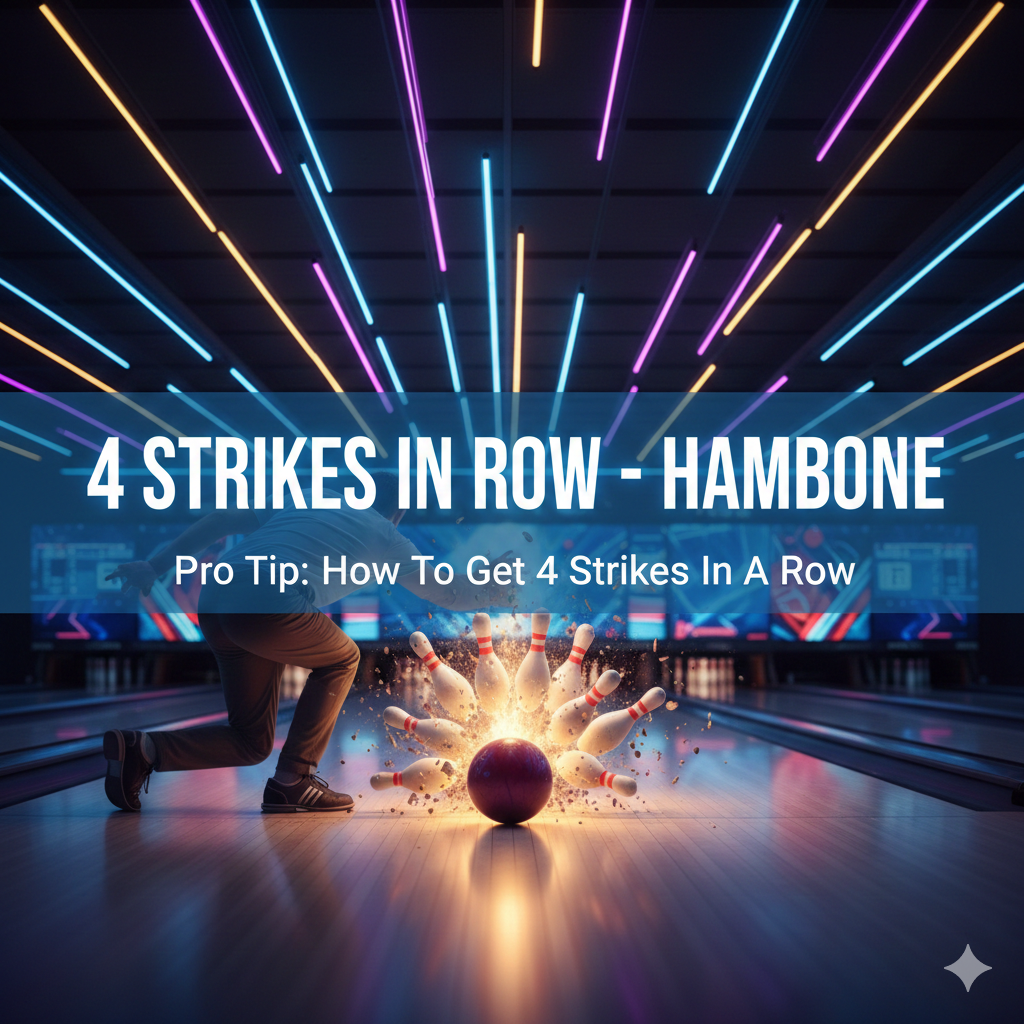

Four strikes in a row is called a Hambone in modern bowling terminology. Achieving four consecutive strikes requires precise timing, stable release mechanics, and dependable ball motion control. Bowlers rely on consistent pocket entry, controlled rev rate, and lane-pattern awareness to repeat the same high-quality shot across multiple frames.
What Is 4 Strikes In a Row Called in Bowling?
Four strikes in a row is officially called a Hambone. The term was introduced and popularized by sports commentator Rob Stone, whose energetic delivery led the phrase into mainstream bowling culture. Although “Hambone” is the modern standard, bowlers occasionally hear older expressions such as four-bagger or double-double, though these lack the widespread adoption of Stone’s terminology.
The Hambone sits within the broader family of consecutive strike names:
- Turkey (3 strikes)
- Hambone (4 strikes)
- Yahtzee (5 strikes)
- Six-pack (6 strikes)
Because four consecutive strikes generate immediate scoring momentum and strong pocket control, bowlers refer to it in contexts such as “4 strikes in bowling,” “4 bowling strikes in a row,” and “a four-bag run.” The Hambone represents both technical success and cultural recognition in the sport.

What Is 4 Strikes In a Row Called in Bowling?
How Bowling Scoring Works When You Hit 4 Strikes In a Row
Four consecutive strikes produce three frames of bonus scoring. Every strike scores 10 pins plus the next two rolls, so consecutive strikes compound value rapidly.
For example:
- Frame 1: Strike → 10 + next two rolls
- Frame 2: Strike → 10 + next two rolls
- Frame 3: Strike → 10 + next two rolls
- Frame 4: Strike → 10 + next two rolls
Numeric Breakdown (Example)
- Frame 1: 10 + 10 + 10 = 30
- Frame 2: 10 + 10 + 10 = 30
- Frame 3: 10 + 10 + X = 30 (if Strike in Frame 4)
- Frame 4: 10 + next two rolls
A Hambone boosts early scoring potential dramatically. Competitive bowlers often convert the first four frames into 90+ points, placing them on pace for 200-level games. Four strikes in a row create immediate psychological and mathematical advantage.
Pro Technique Guide: How To Get 4 Strikes In a Row
The following core techniques improve a bowler’s probability of generating four consecutive strikes by controlling ball entry angle, rotational energy, and release timing.
Align your starting position according to lane oil pattern length.
On a 40-foot house shot, alignment often begins between boards 10–15. On shorter or longer patterns, bowlers adjust entrance angles to find optimal skid-to-hook balance. Proper alignment ensures the ball travels through the intended breakpoint before entering the pocket. Stable alignment reduces variability across multiple frames.
Control your launch speed to maintain energy through the pocket.
Ball speed influences deflection, entry angle, and pin carry. Speeds that are too high deflect the ball off the pocket; speeds that are too low create early hook and weak hits. Maintaining a repeatable speed window—commonly 16–18 mph for league bowlers—supports consistent pocket motion for multiple strikes.
Position your hand behind the ball to maximize forward roll.
A stable hand position reduces unwanted axis rotation and creates clean, direct revolutions. The ball reads the oil pattern more predictably, preventing sudden over-hook or under-reaction. Forward roll increases continuation through the pocket, improving strike potential across consecutive frames.
Time your release to fit the 0.02–0.05 second timing window.
Elite bowlers release the ball within extremely tight timing tolerances, producing reliable rotational patterns. Delayed or rushed timing affects ball motion and disrupts streaks. Maintaining synchronized slide-to-release timing ensures the ball reads friction the same way each shot.
Stabilize your approach rhythm.
Rhythm consistency influences direction, balance, and rotational energy. A smooth 4-step or 5-step approach stabilizes launch parameters and reduces drift across the approach. Consistent footwork helps bowlers reproduce shot number four under pressure.
Increase rev rate using a clean, firm release.
Higher rev rates enhance hook potential and entry angle, but only when controlled. Bowlers use fingertip grip pressure, clean exit rotation, and consistent axis tilt to increase revs without losing precision. Increased rev rate produces stronger pin carry on marginal hits.
Adjust angles based on lane transition.
Oil patterns change every shot. After two or three strikes, the ball may hook earlier due to developing friction. Bowlers adjust starting boards, target boards, or launch angles by 1–3 boards during transitions. Small adjustments maintain pocket entry for strikes three and four.
Focus on pocket entry: right-handers 1–3, left-handers 1–2.
Pocket entry remains the most reliable path to generating a streak. Right-handers target the 1–3 pocket; left-handers target the 1–2 pocket. Maintaining consistent pocket access—rather than perfect carry—is the core factor behind generating a Hambone.
Control your breakpoint location.
The breakpoint is the point where the ball transitions from skid to hook. On medium house shots, common breakpoints fall around board 5–8 at 40 feet. Consistent breakpoint placement ensures stable ball reaction across multiple strikes.
Maintain comfort and motion consistency with performance apparel.
Stable apparel—especially lightweight sublimated jerseys such as EFX Bowling Jerseys —supports unrestricted movement. Consistent shoulder mobility, breathability, and fit contribute indirectly to repeatable approach mechanics. Some bowlers prefer branded lines like Hammer Bowling Jerseys when they want a firmer, performance-focused feel during competitive play.

Pro Technique Guide: How To Get 4 Strikes In a Row
Pocket Entry: The #1 Factor Behind Consecutive Strikes
Pocket entry is the ball’s precise impact point between the headpin and the adjacent pin (1–3 for right-handers, 1–2 for left-handers). Pocket hits produce the ideal deflection chain for strike carry.
Pocket hit variations:
- High-flush strikes — ball drives strongly through the 5-pin, minimal deflection
- Light-mixers — ball enters with slight deflection, pins mix across the deck
- Messenger shots — a pin flies across to knock out the 10-pin or 7-pin
Controlling pocket entry ensures strike reliability and makes four-strike streaks achievable. Bowlers who keep all four shots in the pocket maximize their Hambone chances.

Pocket Entry: The #1 Factor Behind Consecutive Strikes
Ball Motion and Lane Conditions That Influence 4 Strikes in a Row
Ball motion consists of three phases:
- Skid — ball glides over heavy oil
- Hook — ball reacts to friction and changes direction
- Roll — ball drives forward into the pocket
Achieving four strikes requires predictable transitions through all three phases.
Oil pattern length plays a major role:
- 40-foot house shot → consistent skid phase, high pocket potential
- 34-foot short pattern → earlier hook, sharper transitions
- 45-foot long pattern → extended skid, controlled hook needed
Bowlers adjust to dryness, early friction, or carry-down:
- Move one board left/right
- Increase or decrease speed
- Adjust release rotation
- Change breakpoint by 1–2 boards
These adjustments ensure sustained strike control across multiple frames.
Release Timing and Footwork: Key to Consecutive Strikes
Release timing influences ball reaction more directly than rev rate or speed. The ideal timing window—0.02–0.05 seconds—keeps the arm swing synchronized with footwork. On a 5-step approach, bowlers match their pushaway with the first step, creating natural tempo. On a 4-step approach, timing begins with a synchronized pushaway and second step.
Shoulder alignment stabilizes the swing plane, ensuring each strike attempt follows the same curving path into the pocket. Consistency across steps leads to streak potential.
Common Mistakes That Prevent Bowlers From Getting 4 Strikes in a Row
- Drifting outside the initial board → disrupts entry angle
- Over-rotating the wrist → unpredictable hook and poor pocket control
- Ball speed too high on dry lanes → weak deflection and missed pocket
- Targeting arrows instead of the breakpoint → inaccurate motion reading
- Ignoring oil transition → ball hooks early after multiple shots
- Overthinking the fourth shot → mental pressure breaks rhythm
- Holding the ball differently each frame → inconsistent release mechanics
- Slowing feet while accelerating the arm → timing breakdown
Identifying these errors helps bowlers maintain the same pocket-quality shot four times in a row.

Common Mistakes That Prevent Bowlers From Getting 4 Strikes in a Row
Mental Game: Staying Composed When You Already Have 3 Strikes (Turkey)
The fourth strike is often the hardest because bowlers become aware of the streak. This psychological shift adds pressure and disrupts mechanics. Staying composed relies on:
- Breath control before stepping onto the approach
- Routine repetition to maintain rhythm
- Visual focus on the intended breakpoint for 1–2 seconds
- A consistent 3-second pacing rhythm from setup to release
Players who treat shot number four exactly like the first three preserve confidence and reduce tension.
Comparison Table: Strike Streak Names in Bowling
A comparison of common strike-streak terms used in modern bowling scoring and culture.
| Consecutive Strikes | Common Term | Symbol/Notation | Usage Level | Context Notes |
|---|---|---|---|---|
| 1 | None (Strike) | X | All levels | Base scoring unit |
| 2 | Double | XX | All levels | Early momentum |
| 3 | Turkey | XXX | Recreational, League | Standard terminology |
| 4 | Hambone | XXXX | League, TV | Popularized by Rob Stone |
| 5 | Yahtzee | XXXXX | Recreational | Fun, informal |
| 6 | Six-pack | XXXXXX | League, Pro | High-performance streak |
These names vary by generation, broadcast style, and local culture.
Final Thoughts on Getting 4 Strikes in a Row
Four consecutive strikes—a Hambone—represent the connection between technique, confidence, and rhythm. Bowlers who control ball motion, pocket entry, and timing create repeatable shots that support streaks and define performance identity. These same qualities mirror the consistency and discipline seen across competitive teams and performance-driven apparel culture.
FAQs
What is 4 strikes in a row called in bowling?
It is called a Hambone, the modern term popularized by Rob Stone and widely used in leagues and televised bowling.
Is a Hambone official bowling terminology?
It is recognized culturally but not codified in rulebooks. However, it is accepted across league and media contexts.
How rare is four consecutive strikes?
Intermediate bowlers achieve it occasionally, while competitive bowlers generate Hambones regularly due to higher pocket control.
What are the odds of rolling four strikes in bowling?
A typical league bowler with a 35–45% strike rate has a 1–4% probability. Higher-average bowlers achieve far greater odds.
Do pro bowlers change balls during strike streaks?
Sometimes. Pros adjust to lane transition and may switch to maintain ideal ball motion.
Why is the fourth strike harder than the first three?
Pressure increases as the streak grows, narrowing the mental focus window and disrupting mechanics.
Does a Hambone guarantee a 200 game?
No. Four strikes offer strong momentum, but open frames and spare accuracy still determine final scoring potential.