
April 18, 2026 10 min read
Resurfacing a bowling ball involves using progressively finer abrasive pads or sandpaper to remove the outer layer of coverstock that has absorbed oil and become saturated, restoring the ball's original surface texture and hook potential. The process requires sanding the entire ball surface systematically with grits ranging from 500-4000 depending on desired finish, using either a ball spinner for professional results or manual sanding with consistent circular or crosshatch patterns. Most bowlers should resurface their reactive resin balls every 60-90 games or when they notice significantly reduced hook, though professional resurfacing costs $30-50 and ensures better results than DIY attempts without proper equipment. Proper resurfacing extends ball life, restores consistent reaction characteristics, and maintains the performance that makes reactive resin technology effective for generating strikes.
Bowling balls require resurfacing when their coverstock becomes saturated with lane oil, creating a barrier that prevents the surface from gripping the lane properly. This saturation manifests as noticeably reduced hook, inconsistent ball reaction, and decreased backend snap even on fresh oil patterns. The ball essentially becomes "lazy," skidding longer and hooking less aggressively than when new despite identical release mechanics.

Track area discoloration represents the most obvious visual indicator—the section contacting the lane develops a shiny, dark appearance contrasting with the ball's original finish. This shine indicates oil saturation and surface polish from lane friction. You might also notice the ball feeling slightly tacky or oily even after cleaning, suggesting oil has penetrated beyond surface-level contamination that wiping removes.
Performance degradation provides clearer resurfacing signals than visual inspection. When your ball consistently misses the pocket light (weak entry angle) despite proper targeting, or when you need to move significantly left (for right-handers) compared to previous sessions on similar oil patterns, the coverstock likely needs restoration. If the ball seems to skid endlessly before making its move, or the backend reaction becomes sluggish and gradual rather than sharp and angular, resurfacing will likely restore proper characteristics. Understanding how to hook a bowling ball helps identify when equipment rather than technique causes hook reduction.
Professional bowlers in Storm bowling jerseys resurface high-use equipment like the Storm Phaze AI bowling jersey every 40-60 games to maintain peak performance, while recreational bowlers can extend to 80-100 games depending on lane conditions and maintenance habits.
|
Resurfacing Frequency |
Games Between Services |
Signs Needed |
|
Professional/tournament use |
40-60 games |
Any performance drop |
|
League bowling (weekly) |
60-90 games |
Reduced hook, inconsistency |
|
Recreational bowling |
90-120 games |
Significantly reduced reaction |
|
Occasional use |
Annual regardless |
Preventive maintenance |
Professional resurfacing at pro shops provides superior results through specialized equipment including ball spinners that rotate balls at consistent speeds while applying even pressure across the entire surface. The spinner ensures uniform material removal and consistent finish characteristics impossible to replicate manually. Pro shop operators possess experience identifying appropriate grit sequences for different ball types and desired finishes, preventing common mistakes that compromise ball performance.

First-time resurfacing should always occur professionally so you can observe proper techniques if you plan eventual DIY attempts. Aggressive surface changes (going from 4000 grit polish to 500 grit or vice versa) warrant professional service since these require extensive material removal best accomplished with proper equipment. Balls showing track area separation, cracking, or other damage need professional assessment before resurfacing since underlying issues might require repair or indicate the ball has reached end of life.
High-performance balls costing $200+ typically justify professional resurfacing's $30-50 cost given the risk of DIY mistakes that could ruin expensive equipment. The peace of mind knowing the job was done correctly often outweighs modest cost savings from DIY attempts. Professional operators also offer surface adjustments beyond simple resurfacing—they can modify factory finishes to create custom surfaces matched to your style and lane conditions. Competitive bowlers wearing Hammer bowling jerseys or Motiv bowling jerseys rely on professional services for precision surface work on premium equipment like the Hammer Black Widow Mania bowling jersey or Motiv Jackal Onyx bowling jersey.

DIY resurfacing saves money on routine maintenance for bowlers with multiple balls requiring frequent service. The initial investment in abrasive pads and basic equipment ($50-100) pays for itself after 3-4 professional resurfacing sessions. However, DIY requires patience, proper technique, and realistic expectations—results won't match professional spinner work but can adequately maintain ball performance between professional services.
DIY works best for maintenance resurfacing (restoring similar grit to factory finish) rather than aggressive surface modifications. Simple 2000-4000 grit refreshing can be accomplished manually with reasonable results, while transforming highly polished surfaces to 500 grit abralon requires more skill and effort. Accept that manual sanding produces less uniform results than spinner work, though proper technique minimizes these differences for practical bowling purposes.
Abralon pads or Siaair pads in various grits form the foundation of resurfacing work. Common grit sequence includes 500, 1000, 2000, 3000, and 4000, though specific sequences depend on desired finish. These pads cost $3-6 each and last for multiple balls before wearing out. Buy multiple pads of each grit since you'll need fresh pads periodically as they wear.
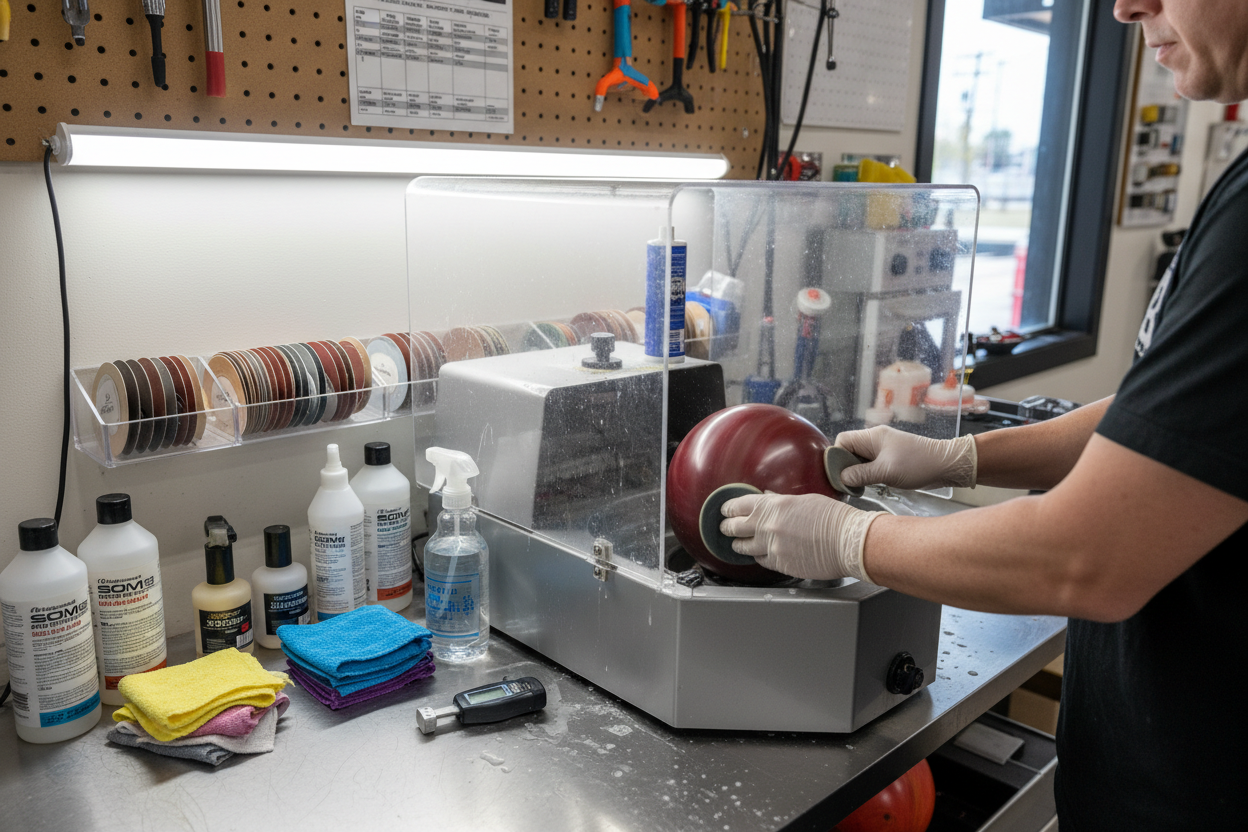
A ball cup or similar holder keeps the ball stable during manual sanding. Purpose-built bowling ball cups cost $15-30, though improvised solutions using towels or rubber mats work adequately. Spray bottle with water or approved bowling ball cleaner provides lubrication during sanding, reducing heat buildup and improving pad efficiency. Microfiber towels for wiping the ball between grit stages remove sanding residue that could contaminate subsequent pads.
A ball spinner dramatically improves DIY results by rotating the ball consistently while you apply pads with even pressure. Entry-level spinners cost $150-250, representing significant investment justified only for serious bowlers maintaining multiple balls frequently. Tack cloths or sticky pads remove fine dust particles between sanding stages, ensuring clean surfaces for subsequent grits. Polish compounds and polish pads create high-gloss finishes if desired after sanding to final grit.
Bowling ball cleaner concentrate mixed with water provides effective lubrication during sanding while simultaneously cleaning the ball. This approach combines resurfacing with deep cleaning, addressing both surface texture and embedded oil simultaneously. Understanding bowling ball types helps identify which materials respond best to different resurfacing approaches.

Start by deep cleaning the ball using approved bowling ball cleaner to remove all surface oil and lane debris. This cleaning prevents contaminating your abrasive pads with oil that reduces their effectiveness. Wipe the ball thoroughly dry before beginning sanding. Identify the ball's current surface finish (check manufacturer specs or pro shop records) to determine appropriate starting grit. If the ball is heavily saturated or last resurfaced to very high grit, you might start with 500 or 1000 grit. Less saturated balls might begin at 2000 grit.
Begin with your starting grit pad, applying light spray of water or ball cleaner to both the ball and pad. Using firm, consistent pressure, sand the entire ball surface in systematic pattern—either continuous circles or crosshatch motion (horizontal then vertical passes). Spend 15-30 seconds on each section, ensuring you cover every square inch including areas between finger holes. The goal involves removing enough material to eliminate the previous surface and expose fresh coverstock.
After completing full coverage with your starting grit, wipe the ball clean and inspect for uniform dull appearance across the entire surface. Shiny spots indicate areas needing additional attention. Once satisfied with uniform coverage, move to the next finer grit (typically double the previous number: 500→1000→2000→4000). Repeat the sanding process with each successive grit, always covering the entire ball systematically. Each grit removes scratches from the previous grit while creating finer scratches itself, progressively smoothing the surface.
Your final grit determines the ball's surface characteristics—500-1000 grit creates aggressive early-rolling surfaces for heavy oil, 2000-3000 grit provides versatile medium surfaces, and 4000 grit with optional polish produces length and backend snap. After your final grit stage, thoroughly clean the ball to remove all sanding residue. If desired, apply polish compound with clean pad, buffing to high gloss finish that further increases length and backend reaction.
Let the ball rest for several hours before use, allowing any residual moisture from the resurfacing process to evaporate completely. Some bowlers apply light coat of ball cleaner and wipe thoroughly as final step, ensuring no sanding residue remains. The freshly resurfaced ball will hook significantly more than the saturated ball you started with—be prepared to adjust your targeting and ball speed accordingly. Professional equipment like the Roto Grip Optimum Idol bowling jersey or 900 Global Zen 25 bowling jersey responds dramatically to proper resurfacing.

Different surface grits create distinct ball motion characteristics suited to varying lane conditions and bowling styles. Understanding grit selection helps you customize ball reaction rather than simply restoring factory finish.
Very dull surfaces create maximum friction with the lane, causing early hook and strong midlane read. These surfaces work best on heavy oil patterns where you need the ball to grip immediately and create strong, continuous arc toward the pocket. The aggressive texture digs into oil, maintaining traction that polished surfaces would lose on high-volume patterns. However, on medium or light oil, these surfaces hook too early and burn energy before reaching the pins, reducing backend continuation and leaving flat corner pins.
Medium surfaces provide balanced characteristics working across broader oil volume ranges. They offer reasonable length with controllable backend motion, making them excellent all-around choices for house shot conditions. Most factory finishes fall within this range, reflecting manufacturers' intent to create broadly applicable out-of-box surfaces. Bowlers maintaining balls at these grits enjoy versatility across typical league and recreational bowling conditions without requiring multiple balls with drastically different surfaces.
Smooth, polished surfaces create maximum length down the lane before the ball encounters sufficient friction to begin hooking. These surfaces excel on broken-down conditions or lighter oil patterns where aggressive surfaces would over-react. The polish allows the ball to skid through the front part of the lane, preserving energy for dramatic backend reaction when it finally grips. However, on fresh heavy oil, polished surfaces may skid too long, missing the pocket weak or even sliding past the breakpoint entirely. Understanding how to spin a bowling ball helps optimize surface selection for your rev rate and style.
Players in Roto Grip bowling jerseys, 900 Global bowling jerseys, or Brunswick bowling jerseys often maintain the same ball at different surface preparations for varying conditions, creating arsenal versatility through surface management rather than purchasing multiple balls.

The most common DIY mistake involves incomplete or inconsistent surface coverage, leaving some areas properly resurfaced while missing others entirely. These inconsistencies create unpredictable ball reaction since different surface areas grip the lane differently. Always sand the entire ball systematically, checking carefully for shiny spots indicating insufficient material removal. Under artificial lighting, inconsistent surfaces show as patches of varying sheen—proper resurfacing produces uniform appearance across the entire ball.
Attempting to jump from 500 grit directly to 4000 grit or similar large gaps produces poor results. Each grit stage removes scratches from the previous grit while creating finer scratches itself—skipping stages leaves deep scratches that subsequent fine grits can't fully remove. These residual scratches create ball reaction inconsistency. Follow proper grit progressions even though they require more pads and time—the results justify the effort. Professional operators never skip stages precisely because proper grit progression determines final surface quality.
Rushing through grit stages without thoroughly covering the ball compromises results. Each grit requires sufficient time to remove the previous surface and establish uniform new texture. Inadequate sanding leaves mixed surfaces combining multiple grit characteristics, creating unpredictable ball motion. Fifteen to thirty seconds per ball section represents minimum time investment—don't shortcut this process attempting to save a few minutes. Quality resurfacing requires patience and thoroughness that cannot be rushed without sacrificing results.
Conversely, excessive resurfacing removes unnecessary coverstock, reducing ball lifespan. Reactive resin balls typically feature 0.5-1.0 inch thick coverstocks that gradually thin with repeated resurfacing. While balls support many resurfacing cycles, unnecessary aggressive sanding accelerates this thinning process. Resurface only when performance demands it rather than following rigid schedules regardless of actual ball condition. Understanding whether bowling balls can be redrilled relates to coverstock thickness management—excessive resurfacing limits future redrilling options.
Proper maintenance between resurfacing sessions extends the time between needed services while maintaining better ball performance. Clean your ball after every bowling session using approved ball cleaner, wiping thoroughly to remove surface oil before it penetrates deeply. This regular cleaning prevents oil saturation from accelerating, meaning you'll get 90-100 games between resurfacing rather than 60-70 games with poor maintenance habits.
Deep cleaning with commercial cleaning machines or hot water extraction removes oil that has penetrated beyond surface level, rejuvenating the ball without removing coverstock material. Many pro shops offer deep cleaning services ($10-20) that restore significant reaction for balls not yet needing full resurfacing. Consider deep cleaning at 30-40 game intervals with full resurfacing every 80-100 games—this combination maintains performance while minimizing coverstock removal.
Store balls away from extreme temperatures and direct sunlight, both of which can damage coverstock materials and accelerate degradation. Room temperature storage in bowling bags protects balls between uses. Avoid leaving balls in hot cars during summer or freezing garages during winter, as temperature extremes compromise coverstock integrity and potentially cause cracking. Professional bowlers in Radical bowling jerseys, Track bowling jerseys, or DV8 bowling jerseys maintain strict ball care protocols maximizing equipment longevity.

Professional resurfacing typically costs $30-50 per ball depending on region and shop rates. Additional services like plug/redrill work, deep cleaning, or custom surface modifications increase these costs. For bowlers maintaining 2-3 balls with quarterly resurfacing needs, annual professional costs reach $240-600—significant investment justifying DIY consideration.
DIY startup costs include abralon pad sets ($60-100 for multiple grits), ball cup ($15-30), spray bottle and cleaning supplies ($15-25), for total initial investment around $90-155. After initial setup, ongoing costs include replacement pads ($3-6 each) as they wear, typically needing fresh pads every 3-4 balls. A bowler resurfacing three balls four times annually spends roughly $50-75 in pads after initial investment—substantial savings compared to $240-600 professional costs.
However, factor in time investment, learning curve, and result quality. DIY resurfacing requires 30-45 minutes per ball initially, decreasing to 20-30 minutes with experience. Professional service takes 10 minutes drop-off/pickup time total. If your time is valuable or you're perfectionistic about results, professional service might justify cost despite cheaper DIY alternatives. Many serious bowlers adopt hybrid approaches—routine maintenance DIY, but major surface changes or problem balls get professional attention.
Resurfacing a bowling ball involves systematically sanding the coverstock with progressively finer abrasive pads (typically 500-4000 grit sequences) to remove oil-saturated material and restore the ball's original surface texture and hook potential. Professional resurfacing at pro shops using ball spinners provides superior results through even coverage and consistent pressure, costing $30-50 but ensuring optimal outcomes for expensive equipment. DIY resurfacing saves money for bowlers maintaining multiple balls frequently, requiring initial investment of $90-155 in tools and supplies but producing adequate results through careful technique and patience. By resurfacing reactive resin balls every 60-90 games or when noticing significantly reduced hook, maintaining proper cleaning habits between services, and selecting appropriate final grit based on lane conditions and desired ball motion characteristics, bowlers extend equipment lifespan while maintaining the consistent reaction characteristics necessary for competitive success and scoring improvement. Visit EFX to discover premium bowling apparel that complements your properly maintained equipment for optimal performance and professional appearance on the lanes.
United States Bowling Congress. (2024). Ball surface maintenance and modification guidelines. USBC Equipment Manual, Chapter 6.
Bowling Pro Shop Association. (2024). Best practices for ball resurfacing and surface management. BPSA Technical Standards, 16(4), 67-89.
Professional Bowlers Association. (2024). Surface preparation strategies for competitive bowling. PBA Equipment Guide, Section 8.
Miller, R. (2023). Coverstock technology and surface maintenance impact on ball performance. Journal of Bowling Equipment, 33(2), 145-168.