
February 03, 2026 15 min read
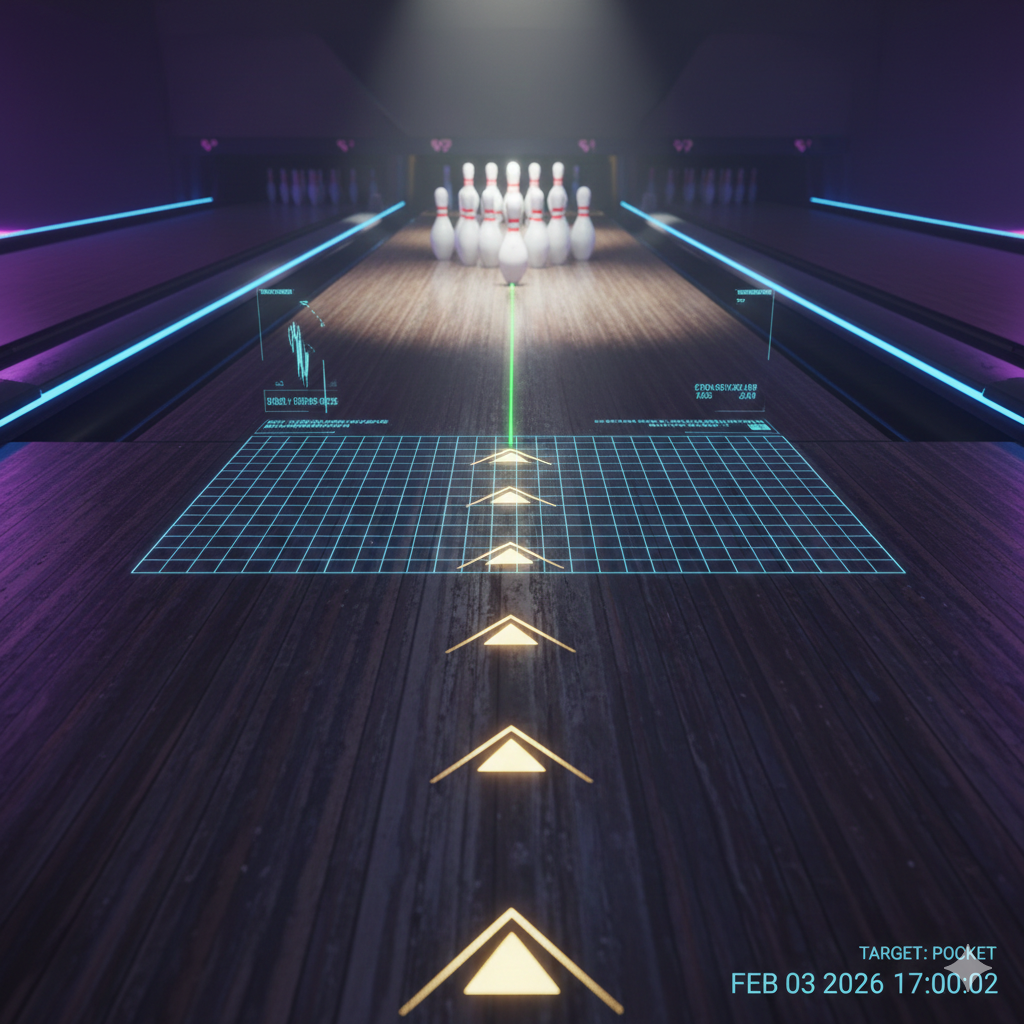
The targets in bowling are called arrows, dots, and pins, each serving specific purposes in the targeting system. The seven triangular arrows embedded in the lane approximately 15 feet from the foul line are the primary targets most bowlers use for aiming. Additional targeting aids include approach dots positioned near the foul line and further back on the approach, plus the rangefinder dots located between the arrows and pins. Understanding how to use these various targeting systems helps bowlers develop consistent accuracy and improve their overall scoring performance.
Bowling lanes feature multiple targeting systems designed to help bowlers aim accurately and maintain consistency. These visual guides provide reference points at different distances, allowing bowlers to develop their preferred aiming method.
The three primary targeting systems work together to create a comprehensive aiming framework. The arrows provide mid-range targets that most bowlers focus on, the approach dots help establish proper foot positioning and starting alignment, and the pins themselves serve as the ultimate target. Professional bowlers develop the ability to use all three systems simultaneously, cross-referencing their position and aim to ensure proper ball path toward the pocket.
Modern bowling lanes feature standardized targeting systems that remain consistent across different centers, allowing competitive bowlers to transfer their skills reliably between venues. This standardization means bowlers wearing custom bowling jerseys in league play can trust that target positioning will be identical whether they're bowling at home centers or tournament locations.
|
Target System |
Location |
Distance from Foul Line |
Primary Users |
Main Purpose |
|
Arrows |
Lane surface |
12-16 feet |
Most bowlers |
Primary aiming point |
|
Approach dots |
Approach area |
0-15 feet behind foul line |
All bowlers |
Foot positioning |
|
Rangefinder dots |
Lane surface |
6-8 feet from foul line |
Advanced bowlers |
Secondary reference |
|
Pins |
End of lane |
60 feet |
Beginning bowlers |
Ultimate target |
The arrows are the most commonly used targeting system in bowling, consisting of seven triangular markers embedded into the lane surface. These arrows are positioned approximately 12-16 feet from the foul line, providing an ideal mid-range target that's close enough to aim at accurately while far enough to establish proper ball trajectory.
The seven arrows are spaced five boards apart on the lane, with the center arrow positioned at the 20th board (the exact center of the 39-board lane). Bowlers typically refer to arrows by their board number or by counting from the center. The center arrow is on board 20, with additional arrows at boards 10, 15, 25, 30, 35, and occasionally boards 5 and 40 depending on lane design. This spacing creates consistent intervals that help bowlers make precise adjustments.
Right-handed bowlers typically target the second arrow from the right (board 10) for pocket hits, while left-handed bowlers aim at the second arrow from the left (board 30). These positions create the optimal entry angle into the 1-3 pocket for right-handers or 1-2 pocket for left-handers. Bowlers adjust their target arrow left or right based on lane conditions, ball reaction, and personal style. Professional bowlers in Storm bowling jerseys constantly adjust their arrow targets throughout competition as oil patterns break down.
Targeting arrows instead of pins improves accuracy because the arrows are much closer to the bowler's release point. At 60 feet away, the pins appear small and difficult to aim at precisely, especially considering that bowlers must account for ball hook and lane conditions. The arrows at 12-16 feet provide a larger, clearer target that's easier to focus on during the approach and release.
The arrow targeting system also simplifies lane adjustment calculations. When a ball misses the pocket, bowlers can make small target adjustments measured in boards rather than trying to estimate angle changes while aiming at distant pins. Moving the target one arrow (five boards) creates a predictable change in ball path that experienced bowlers can calculate mentally. Understanding how to improve bowling accuracy involves mastering arrow targeting before attempting more advanced techniques.
|
Arrow Position |
Board Number |
Typical Use |
Distance from Center |
|
Far right |
5 |
Extreme angle shots |
15 boards right |
|
Second from right |
10 |
Strike ball (righties) |
10 boards right |
|
Third from right |
15 |
Spare shooting |
5 boards right |
|
Center arrow |
20 |
Straight shots, some spares |
Center |
|
Third from left |
25 |
Spare shooting |
5 boards left |
|
Second from left |
30 |
Strike ball (lefties) |
10 boards left |
|
Far left |
35 |
Extreme angle shots |
15 boards left |
The approach dots serve as positioning targets that help bowlers establish consistent starting positions and alignment. These dots appear in two sets on the approach area, providing reference points for foot placement during the approach.
The front set of dots appears approximately 12 inches behind the foul line, consisting of seven dots that align with the seven arrows on the lane. These dots help bowlers verify their finishing position and ensure proper foot placement at the foul line. Bowlers check that their sliding foot ends near the appropriate dot to maintain consistency from shot to shot.
The front dots also serve as reference points for spare shooting systems. Many bowlers use a spare shooting method where they move their feet to specific dots while keeping their target arrow constant, creating different angles for various spare leaves. This systematic approach removes guesswork from spare conversion and builds reliable muscle memory for common spare combinations.
The back set of approach dots appears approximately 12-15 feet behind the foul line, positioned where most bowlers begin their approach. These dots help establish consistent starting positions that ensure proper spacing for four-step or five-step approaches. Bowlers align their starting foot position relative to these back dots, creating a repeatable foundation for their approach.
Competitive bowlers develop specific starting positions measured in relation to the back dots. A right-handed bowler might consistently start with their left foot on the second dot from the right, ensuring identical foot positioning for every shot. This consistency eliminates one variable in the complex equation of bowling accuracy, allowing bowlers to focus on timing and release mechanics. Teams wearing matching Hammer bowling jerseys during league competition often share starting position strategies within their team.
|
Dot Set |
Location |
Primary Function |
Typical Use |
|
Front dots |
12" behind foul line |
Finishing position verification |
All bowlers |
|
Back dots |
12-15' behind foul line |
Starting position reference |
All bowlers |
|
Middle dots (some centers) |
6-8' behind foul line |
Intermediate positioning |
Advanced bowlers |
Rangefinder dots, also called midpoint dots or intermediate dots, appear on the lane surface approximately 6-8 feet from the foul line. These dots provide secondary reference points that some advanced bowlers use to verify ball trajectory early in its path down the lane.
The rangefinder dots help bowlers confirm that their ball is traveling on the intended path shortly after release. If a bowler targets the second arrow but notices the ball crossing the wrong rangefinder dot, they know to adjust their approach or release angle. This early feedback system helps prevent repeating the same mistake and allows for quicker corrections during practice or competition.
Not all bowlers consciously use rangefinder dots in their targeting system. Beginning and intermediate bowlers typically focus exclusively on the arrows, while advanced bowlers might incorporate rangefinder dots as a secondary checkpoint without making them the primary focus. Professional bowlers wearing Motiv bowling jerseys often use peripheral vision to track ball path across rangefinder dots while maintaining primary focus on their arrow target.

The ten bowling pins arranged in a triangular formation at the lane's end serve as the ultimate target, though they function differently than the arrows and dots used for aiming. Understanding pin positioning and pocket targets helps bowlers visualize the desired ball path even when using closer aiming points.
Bowling pins are numbered 1-10, with the head pin (pin 1) positioned at the front of the triangle closest to the bowler. The numbering system proceeds from front to back in rows: pin 1 in the first row, pins 2 and 3 in the second row, pins 4, 5, and 6 in the third row, and pins 7, 8, 9, and 10 in the back row. This standardized numbering system allows bowlers to communicate precisely about spare leaves and pin combinations.
The pocket—the space between pins 1 and 3 for right-handed bowlers or pins 1 and 2 for left-handed bowlers—represents the optimal target area for strike shots. Balls entering the pocket at the proper angle create pin action that carries back to the remaining pins, producing strikes more consistently than head-on hits. Understanding pin positioning helps bowlers select appropriate arrow targets that create the correct pocket entry angle.
Beginning bowlers often naturally look at the pins because they represent the obvious target, but this habit usually prevents accuracy development. The pins are too far away to provide precise aiming feedback, and their distance makes it difficult to judge angle adjustments. Most bowling instruction emphasizes transitioning from pin targeting to arrow targeting as quickly as possible.
However, pins become relevant targets for specific spare shooting situations. When shooting at single-pin spares on the extreme edges (7-pin or 10-pin), some bowlers use direct pin targeting because the angle is so severe that arrow targeting becomes less reliable. The choice between arrow targeting and pin targeting for spares depends on individual preference, spare leave difficulty, and bowler experience level. Reading about spare conversion techniques helps bowlers understand when pin targeting might be appropriate.
|
Pin Number |
Position in Formation |
Common Spare Leaves |
Difficulty Level |
|
1 (Head pin) |
Front center |
1-pin alone (rare) |
Easy |
|
2, 3 |
Second row |
2-pin, 3-pin (common) |
Moderate |
|
5 (Kingpin) |
Center third row |
5-pin alone (common) |
Easy |
|
7, 10 |
Back corners |
Corner pins (most common) |
Hard |
|
4, 6 |
Third row sides |
Baby splits |
Moderate-Hard |
|
8, 9 |
Back middle |
Middle back pins |
Moderate |
|
7-10 split |
Back corners both |
True split |
Nearly impossible |
Beyond visible targets like arrows and dots, bowling lanes feature an invisible but crucial targeting system: the 39 boards that run the length of the lane. Understanding board counting helps bowlers make precise adjustments and communicate effectively about targeting.
Bowling lanes consist of 39 individual boards, each approximately one inch wide, numbered from 1-39 starting from the right edge (for right-handed bowlers) or sometimes from the left edge depending on regional convention. The center board is board 20, serving as the lane's reference point. Arrows align with specific board numbers, making board counting integral to arrow targeting.
Experienced bowlers think in terms of boards rather than just arrows. Instead of saying "I'm targeting the second arrow," they might say "I'm targeting board 10," which provides more precision since they can also reference boards between arrows. This board-level precision allows for micro-adjustments of one or two boards when fine-tuning ball path for specific lane conditions.
The board system enables systematic adjustments using the "3-1-2 rule" or similar adjustment methods. When a strike ball misses the pocket, bowlers can move their feet three boards and adjust their target one board in the same direction, creating a 2-board difference in breakpoint. This mathematical approach removes guesswork from lane adjustments and helps bowlers adapt to changing oil patterns during competition.
Board targeting becomes especially important on sport patterns and challenging oil conditions where precision matters significantly. Tournament bowlers wearing pro-designed bowling jerseys rely on board-level adjustments to stay in the pocket as lane conditions transition throughout qualifying rounds.

Bowlers use various targeting methods depending on their skill level, bowling style, and personal preferences. Understanding these different approaches helps bowlers find the system that works best for their game.
Spot bowling, where bowlers target the arrows, represents the most common and recommended targeting method. This approach provides a close, clear target that's easy to aim at consistently. Spot bowlers develop the ability to walk naturally while focusing their eyes on a specific arrow, allowing their peripheral vision to track the ball's path without losing sight of the target.
The spot bowling method works well for bowlers of all skill levels because it simplifies the aiming process and enables consistent repetition. By focusing on a target only 12-16 feet away instead of 60 feet away, bowlers can more easily identify and correct aiming errors. Most bowling instruction programs teach spot bowling as the fundamental targeting method before introducing more advanced techniques.
Pin bowling involves looking directly at the pins and aiming the ball toward them without using intermediate targets. This method works better for straight-ball bowlers who don't need to account for significant hook, but it presents challenges for modern bowlers who use reactive resin balls with substantial hook potential. The distance to the pins makes precise aiming difficult, and the method doesn't account for ball reaction on different lane conditions.
Some experienced bowlers successfully use pin bowling for specific spare situations, particularly for corner pins where the angle is so severe that arrow references become less helpful. However, most bowling coaches discourage pin bowling as a primary method because it limits adjustment precision and makes it harder to develop consistent accuracy. Understanding bowling fundamentals includes learning why arrow targeting surpasses pin targeting for most situations.
Line bowling represents an advanced targeting method where bowlers visualize the complete ball path from release point through breakpoint to pocket. Instead of focusing on a single target point, line bowlers track the entire trajectory, using arrows, rangefinder dots, and breakpoint as checkpoints along the intended path. This method requires significant experience and spatial awareness but provides comprehensive ball path feedback.
Professional bowlers often employ line bowling during competition because it allows them to verify ball reaction at multiple points along the lane. If the ball crosses the correct arrow but misses the intended breakpoint, the bowler knows the ball's hook potential doesn't match the lane condition. This multi-point feedback system enables faster and more accurate adjustments than single-target methods. Competitive bowlers in ball-inspired bowling jerseys frequently use line bowling to maximize their adjustment efficiency.
|
Targeting Method |
Skill Level |
Primary Focus Point |
Best For |
Limitations |
|
Spot bowling |
All levels |
Arrows (12-16 feet) |
Consistency, beginners |
Less feedback on ball reaction |
|
Pin bowling |
Beginner-intermediate |
Pins (60 feet) |
Straight-ball bowlers |
Poor precision, no adjustment system |
|
Line bowling |
Advanced-professional |
Entire ball path |
Competition, adjustment |
Requires experience, can be overwhelming |
|
Board counting |
Intermediate-advanced |
Specific board numbers |
Precise adjustments |
Requires knowledge of lane play |
Selecting the appropriate target depends on multiple factors including your bowling style, lane conditions, and competitive situation. Developing a systematic approach to target selection improves consistency and scoring.
Right-handed bowlers typically start by targeting the second arrow from the right (board 10) for strike shots. This target creates the proper entry angle into the 1-3 pocket for most house shot conditions. As oil patterns break down or when bowling on sport patterns, right-handed bowlers adjust their target left (toward higher board numbers) to compensate for increased hook potential.
For spare shooting, right-handed bowlers often move right and target the center arrow (board 20) or arrows even further left when shooting at left-side spares. This cross-lane targeting creates the angle needed to convert corner pins and other spare leaves on the opposite side of the lane. Developing a consistent spare system based on target arrows provides the foundation for high spare conversion percentages.
Left-handed bowlers mirror the right-handed approach, typically targeting the second arrow from the left (board 30) for strike shots. This target provides the optimal entry angle into the 1-2 pocket under standard conditions. Left-handed bowlers face unique challenges because they typically bowl on less broken-down oil patterns since fewer lefties bowl in most leagues, meaning lane conditions change differently throughout sessions.
Spare shooting for left-handed bowlers involves moving left and targeting arrows toward the right side of the lane when shooting at right-side spares. The systematic approach remains identical to right-handed methods, just mirrored to the opposite side. Left-handed bowlers wearing Storm bowling jerseys often develop strong spare shooting skills due to their experience reading fresh oil patterns.
Beyond basic arrow targeting, advanced bowlers develop sophisticated targeting methods that incorporate multiple reference points and account for varying lane conditions. These techniques separate competitive bowlers from recreational players.
Breakpoint targeting involves identifying where the ball should transition from skid phase to hook phase, typically occurring 35-45 feet down the lane. Advanced bowlers visualize this breakpoint and select their arrow target based on creating the correct ball path to that spot. The breakpoint serves as a critical checkpoint that indicates whether ball speed, rev rate, and surface preparation are properly matched to lane conditions.
Monitoring breakpoint throughout a session helps bowlers make proactive adjustments before their strike ball completely misses the pocket. If the breakpoint gradually moves left as oil breaks down, bowlers adjust their target or starting position to maintain proper pocket entry. This attention to breakpoint changes allows professional bowlers to stay ahead of lane transitions rather than reacting after several missed shots.
Different oil patterns require different targeting strategies. House shots with heavier oil in the middle and dry boards outside allow bowlers to target closer to the center of the lane with confidence their ball will hook back to the pocket. Sport patterns with flatter oil distribution require more precise targeting and smaller margin for error, often necessitating target adjustments measured in single boards rather than full arrows.
Bowlers must adjust targets as lane conditions change throughout play. Fresh oil requires targeting further outside (lower board numbers for righties) because the ball won't hook as much. As oil breaks down after several games, bowlers move their target inside (higher board numbers) to use the fresh oil and prevent their ball from over-hooking. Professional bowlers make these adjustments continuously, sometimes changing targets between frames based on ball reaction feedback.
Even experienced bowlers make targeting errors that prevent consistent scoring. Recognizing and correcting these mistakes improves accuracy and overall performance.
Many bowlers struggle with target fixation issues where they start by looking at the correct arrow but unconsciously shift their focus to the pins during their approach. This focus shift changes the subconscious aiming calculations that the brain makes, resulting in inaccurate shots despite good physical mechanics. Maintaining consistent focus on the chosen arrow from the start of the approach through ball release is essential for repeatable accuracy.
Another common mistake involves targeting too many reference points simultaneously without a clear hierarchy. Bowlers who try to watch the dots, arrows, rangefinder dots, and pins all at once often end up not really focusing on any target clearly. Establishing one primary target (usually an arrow) and using other reference points peripherally provides better results than trying to consciously track multiple targets.
Changing targets between shots without clear reasons creates inconsistency and makes it impossible to determine whether poor results come from execution errors or targeting errors. Bowlers should commit to a specific target and execute multiple shots before making adjustments. This commitment allows proper evaluation of whether the chosen target produces the desired ball path or needs modification.
Failing to adjust targets when lane conditions change represents another critical error. Bowlers who stubbornly maintain their original target while lane conditions transition find themselves constantly missing the pocket despite good execution. Reading lane conditions and making appropriate target adjustments separates good bowlers from great ones. Understanding proper bowling technique includes knowing when and how to adjust targets based on ball reaction.
Developing consistent targeting accuracy requires focused practice that emphasizes aiming fundamentals over score accumulation. Structured target practice builds the muscle memory and mental focus needed for competitive success.
Shadow bowling without a ball helps bowlers groove their approach while maintaining perfect focus on their chosen target arrow. Walk through your normal approach while staring at the target arrow, noting whether your eyes remain fixed on that spot or wander toward other reference points. Repeat this drill until you can complete your entire approach with unwavering target focus.
Scoring-free target practice removes the pressure of pins and scores, allowing bowlers to concentrate purely on hitting their intended target. Roll 10-15 shots in a row aimed at a specific arrow, evaluating each shot based solely on whether the ball crossed that arrow rather than whether it struck. This practice builds target confidence and helps identify consistent aiming errors that need correction. Bowlers in Motiv bowling jerseys often dedicate entire practice sessions to target work without keeping score.
Repetition creates the muscle memory necessary for consistent targeting. Roll the same shot repeatedly from the same starting position to the same target until the motion becomes automatic and requires minimal conscious thought. This repetition training helps bowlers maintain accuracy even under competitive pressure when conscious thought might be disrupted by stress or distraction.
Video analysis helps bowlers verify that their head and eye position remain consistent throughout the approach. Recording your approach from the side angle reveals whether your head drops, tilts, or moves during your approach, all of which can affect targeting accuracy. Making corrections based on video feedback accelerates target accuracy development compared to relying solely on subjective feel.
|
Practice Drill |
Duration |
Focus Area |
Frequency |
|
Shadow bowling |
5-10 minutes |
Target focus maintenance |
Before every session |
|
Single-arrow targeting |
10-15 shots |
Hitting specific target |
2-3 times per week |
|
Target transition drill |
20 shots |
Moving between targets |
Weekly |
|
Spare shooting system |
15-20 shots |
Systematic spare targeting |
Every session |
|
Video analysis |
Full session review |
Head/eye position verification |
Bi-weekly |
Understanding what the targets in bowling are called and how to use them effectively provides the foundation for consistent accuracy and improved scoring. The arrows serve as the primary targeting system for most bowlers, supported by approach dots for positioning and rangefinder dots for trajectory verification. Developing proficiency with spot bowling techniques, learning systematic target adjustments for varying lane conditions, and practicing dedicated target drills separates recreational bowlers from competitive players. By committing to proper targeting fundamentals and avoiding common mistakes like shifting focus or inconsistent target reference, bowlers at all skill levels can significantly improve their accuracy and overall performance. Visit EFX to discover premium bowling apparel that helps you look professional while you master these targeting techniques on the lanes.
Bowling Proprietors' Association of America. (2024). Lane specifications and targeting system standards. BPAA Technical Guidelines.
Professional Bowlers Association. (2024). Advanced targeting techniques for competitive bowling. PBA Coaching Manual, 8th Edition, 45-78.
United States Bowling Congress. (2024). Equipment specifications and lane marking requirements. USBC Rule Book, Section 4.
Weber, D., & Anthony, E. (2023). Targeting systems and their impact on bowling accuracy. Journal of Bowling Biomechanics, 31(2), 89-106.