
December 01, 2025 6 min read
Every serious bowler knows the right equipment can transform their game, but understanding why one ball reacts differently from another starts with knowing its core dynamics. Among the most important numbers you’ll see on a spec sheet are RG (Radius of Gyration) and Differential (Diff). These values determine how your ball stores and releases energy, how early it reads the lane, and how sharp it hooks on the backend. In this guide from Apparel EFX, we’ll break down RG, Diff, and Intermediate Differential in plain language, show how they interact, and help you choose the perfect setup for your style and lane conditions.
Every bowling ball has a unique fingerprint that determines how it behaves on the lane. One of the most important specs you’ll see on a bowling ball’s sheet is RG, or Radius of Gyration. Understanding RG helps bowlers select a ball that matches their delivery style and the conditions they play on.
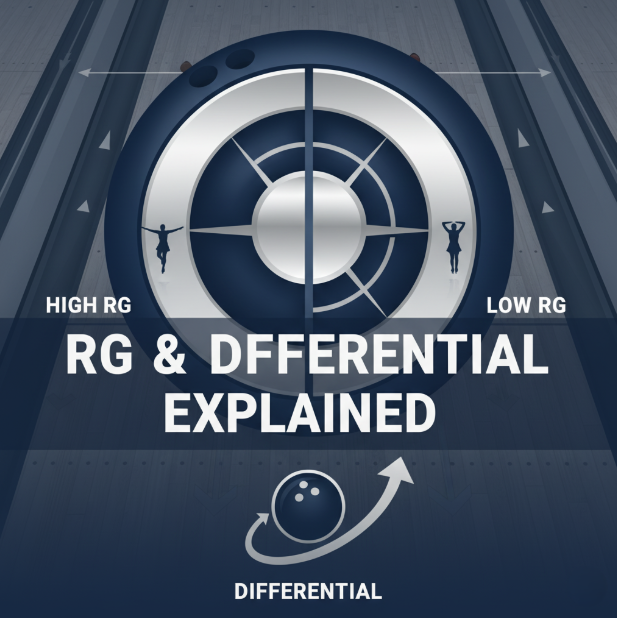
RG stands for Radius of Gyration, a measurement that describes how a ball’s mass is distributed around its center. Technically, it’s the distance from the axis of rotation at which the ball’s mass could be concentrated without changing its moment of inertia.
Low RG (≈ 2.47–2.50): Mass is closer to the center. The ball revs up quickly, reads the lane earlier, and rolls sooner.
High RG (≈ 2.57–2.60): Mass is farther from the center. The ball skids longer before hooking, making it ideal for drier lane conditions or higher-speed players.
Think of a figure skater: when they pull their arms in (mass toward center), they spin faster—like a low RG ball revving up early. When they extend their arms (mass outward), they spin slower—like a high RG ball gliding downlane.
RG controls the length and energy transfer of a ball’s motion:
Low RG = early revs, stronger midlane roll, ideal for heavy oil.
High RG = later revs, more energy at the backend, ideal for dry lanes or high-speed bowlers.
When you see a spec sheet listing an RG number, it tells you how soon or late the ball will start to roll. A ball with lower RG will “read” earlier, while one with higher RG conserves energy and hooks later.
Understanding this helps bowlers fine-tune their arsenal by combining early-rolling and long-skidding balls for different lane conditions.

While RG shows how mass is distributed, Differential (Diff) measures the difference between the ball’s highest and lowest RG axes—essentially how much the shape of the core influences motion.
Total Differential is the numerical difference between the maximum and minimum RG values of a bowling ball’s core.
High Differential (≈ 0.050–0.060): Greater potential for track flare and stronger hook motion.
Low Differential (≈ 0.020–0.030): Smoother motion with less overall hook.
A ball with a higher differential creates more flare potential, meaning the oil rings on the ball’s surface separate with each revolution—helping maintain fresh surface contact and stronger backend motion.
Intermediate Differential, found in asymmetric cores, measures the difference between the intermediate and minimum RG. It affects how sharply or smoothly a ball transitions from skid to hook to roll.
High intermediate diff = stronger direction change and angular motion.
Low intermediate diff = smoother, more controllable backend.
This makes intermediate differential important for advanced bowlers fine-tuning ball motion or playing on sport patterns where precision and transition control matter.
Flare potential describes how many distinct oil rings appear on the ball after a shot—visual evidence of differential at work. High-flare balls (high diff) dig into the lane harder, while low-flare balls glide with minimal movement. Understanding flare helps players manage hook shape and control in transition zones.
RG and Diff don’t operate in isolation. Their combination defines how your ball behaves from release to impact.
A low RG + high Diff ball revs early and creates a strong, angular motion at the backend. It’s perfect for heavy oil and strong-handed bowlers (crankers) who want maximum traction and hook.
A high RG + low Diff ball delays its hook and delivers a smoother arc—ideal for dry lanes, speed-dominant bowlers, or when control is more important than power.
Between those extremes, you’ll find medium RG/medium Diff options balancing length and motion. Still, coverstock type and surface finish significantly modify results:
Polished pearl covers add length and backend snap.
Matte or sanded solids smooth transitions and grip earlier.
In other words, RG and Diff shape the “core behavior,” but coverstock decides how that energy interacts with the lane.

When browsing bowling balls—especially from pro shops or online—spec sheets reveal critical motion clues.
|
Specification |
Low Range |
Medium Range |
High Range |
Common Use Case |
|
RG |
2.47–2.50 |
2.51–2.54 |
2.55–2.60 |
Early roll vs. length |
|
Diff |
0.020–0.030 |
0.035–0.045 |
0.050–0.060 |
Flare & hook strength |
(Sources: StormBowling, BowlingBallDepot, USBC technical standards)
Strokers / Control Bowlers: Medium RG, low Diff for predictability.
Tweeners: Mid RG, medium Diff for balanced roll.
Crankers: Low RG, high Diff for maximum hook potential.
Compare spec sheets to your style and lane type, not just brand hype. Subtle differences (like RG 2.49 vs 2.53) can alter reaction timing significantly.
Many bowlers overvalue RG alone, but coverstock and surface prep influence reaction even more. A high-RG solid ball can still read early if the cover is strong and dull. As a rule, think:
“RG and Diff set the framework. The coverstock paints the picture.”
|
Bowler Type |
Lane Condition |
Recommended RG |
Recommended Diff |
Typical Ball Motion |
|
Stroker |
Dry / Medium |
2.55+ |
≤0.035 |
Late hook, smooth arc |
|
Tweener |
Medium / Heavy |
2.51–2.54 |
0.035–0.045 |
Controlled backend |
|
Cranker |
Heavy |
≤2.50 |
≥0.050 |
Early revs, strong backend |
Hammer Black Widow 3.0: RG 2.48, Diff 0.058 – early roll + aggressive backend.
Storm Hy-Road Pearl: RG 2.57, Diff 0.046 – long skid, sharp backend.
Brunswick Defender Hybrid: RG 2.473, Diff 0.054 – balanced midlane control.
Explore designs inspired by top brands and athletes through EFX’s Hammer Bowling Jerseys Collection—built for players who match style with precision performance.
In tropical regions like Vietnam or Southeast Asia, higher humidity and warmer lane surfaces can affect oil breakdown faster.
Opt for slightly higher RG balls to maintain skid.
Keep surfaces clean—oil absorption increases early hook.
Choose breathable jerseys for comfort and control. (Check EFX All Bowling Jerseys for performance-fit apparel designed for these conditions.)
Before purchase:
Verify RG and Diff on manufacturer specs.
Match with your lane conditions (league vs. sport pattern).
Ask your pro shop for layout suggestions based on PAP and rotation.
Before drilling:
Discuss balance hole legality and layout impact on flare potential.
Consider surface prep (polish, sanding) before final fit.
After use:
Clean and resurface regularly to preserve reaction.
Track oil ring spacing to monitor flare and energy efficiency.
Re-evaluate specs after ~100–150 games or when ball motion fades.

Summary & Key Takeaways
RG (Radius of Gyration) shows how soon your ball revs up: low RG = early roll; high RG = longer skid.
Differential (Diff) measures flare potential: high Diff = stronger hook; low Diff = smoother motion.
Their interplay defines overall motion, but coverstock and surface finish refine the shape.
Always choose ball specs that fit your delivery style, lane condition, and desired motion.
Ready to match your specs with your style? Explore EFX’s full bowling jersey line—engineered for competitive comfort and style that performs as strong as your game.
RG (Radius of Gyration) indicates how the mass of a ball is distributed. It tells you how early or late the ball begins to roll.
Look for lower RG values (2.47–2.50) paired with high Differential for earlier traction.
It measures the difference between max and min RG, representing flare potential and hook strength.
Both matter, but coverstock and surface finish usually have a larger influence on motion shape.
Typically every 150–200 games, or when the surface and reaction noticeably fade even after maintenance.