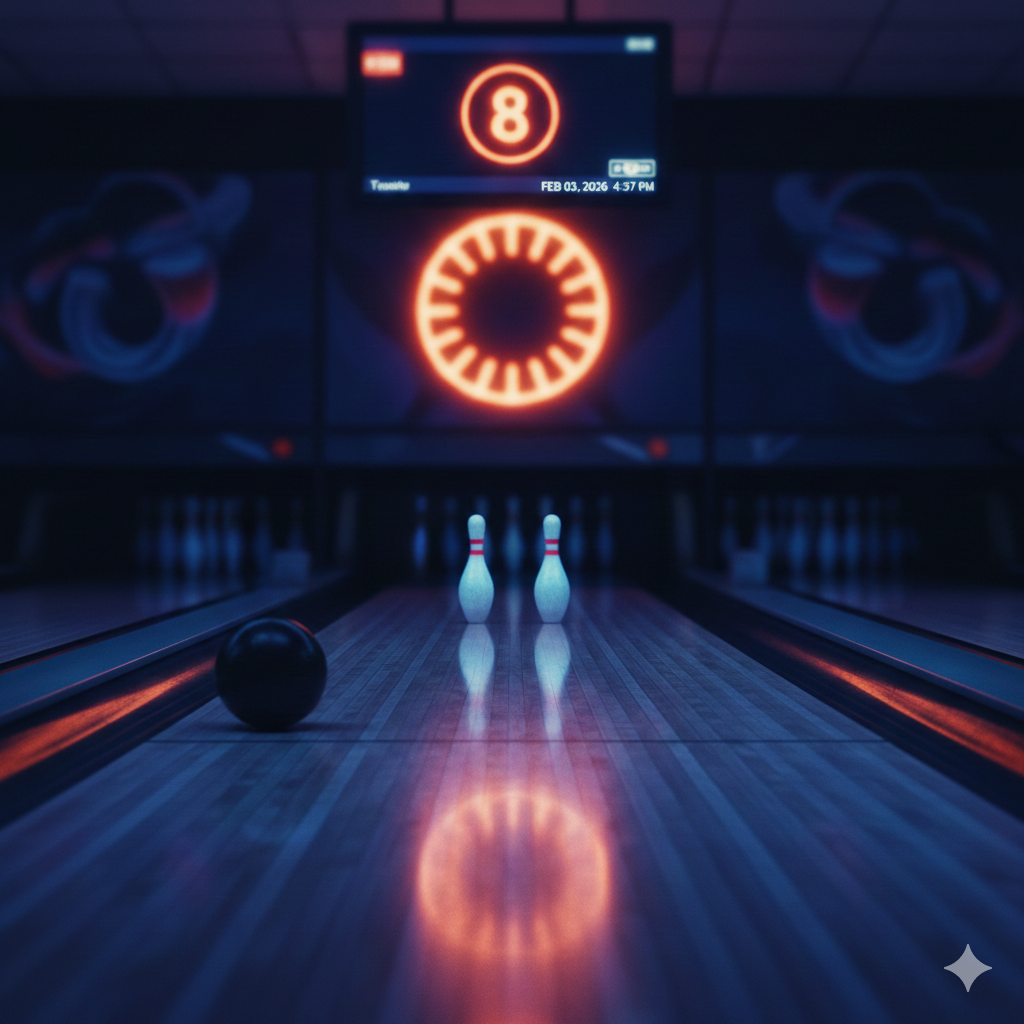

Circled numbers on bowling scoresheets represent missed spare opportunities, also known as open frames. When you knock down pins on your first ball but fail to convert the spare on your second attempt, the scorekeeper circles that frame's total to indicate an incomplete scoring opportunity. Understanding this scoring notation helps bowlers track performance patterns and identify areas for improvement, making it an essential element of the game's traditional scoring system.
A circled number in bowling scoresheet indicates an open frame where the bowler failed to knock down all ten pins within two attempts. This visual marker helps distinguish incomplete frames from strikes and spares, providing immediate feedback about missed scoring opportunities.
A circled number represents the total number of pins knocked down in that frame. For example, if you knock down seven pins on your first ball and two pins on your second ball, the number "9" would be circled in that frame's box. This notation immediately tells anyone reviewing the scoresheet that nine pins were knocked down, but one pin remained standing after both attempts.
The circle symbol serves multiple purposes in traditional scorekeeping. It allows league secretaries to quickly verify scores, helps bowlers identify consistency patterns, and provides clear documentation for tournament officials when reviewing game results. Many competitive bowlers wearing custom bowling jerseys study their circled numbers to identify weaknesses in their spare shooting game.
Open frames significantly impact your overall score because they eliminate all bonus scoring potential. Unlike strikes and spares, which allow you to add bonus pins from subsequent rolls, an open frame's score is final once recorded. This makes the circled number notation particularly important for competitive bowlers analyzing their games.
|
Scoring Outcome |
Symbol Used |
Bonus Potential |
Maximum Frame Value |
|
Strike |
X |
Next 2 balls added |
30 points |
|
Spare |
/ |
Next 1 ball added |
20 points |
|
Open Frame |
Circled number |
No bonus |
9 points |
|
Gutter balls |
- or 0 |
No bonus |
0 points |
The traditional manual scoring system has been the foundation of bowling for decades, using specific symbols and notations to track game progress. Understanding this system reveals why circled numbers became such an important part of bowling's scoring language.
Traditional bowling scoring relies on a manual scoresheet system where each frame contains specific boxes for recording different scoring outcomes. The scoresheet includes ten frames with small boxes in the upper corners for marking first and second ball results, plus a larger area below for recording the cumulative score. The scoring hierarchy prioritizes strikes as the highest-value outcome, followed by spares, and finally open frames as the least desirable result.
Cumulative scoring makes bowling unique because each frame's score depends on what happens in subsequent frames when strikes or spares are involved. This interdependence makes the circled number particularly significant because it represents a "dead end" in scoring potential where no future bonus points can be added to that frame. Bowlers in Storm bowling jerseys often study these scoring mechanics to maximize their competitive advantage.
|
Frame Sequence |
Frame 1 Result |
Frame 2 Result |
Frame 1 Final Score |
Explanation |
|
Scenario A |
Strike (X) |
Strike (X) |
20 + next ball |
Both strikes add to frame 1 |
|
Scenario B |
Spare (/) |
Strike (X) |
20 points |
Strike ball adds to spare frame |
|
Scenario C |
Open (8 circled) |
Strike (X) |
8 points |
No bonus despite next strike |
|
Scenario D |
Open (9 circled) |
Open (7 circled) |
9 points |
Both frames score pin count only |
The practice of circling open frame numbers serves both practical and psychological purposes in bowling. This notation system has evolved into a standardized method for quickly identifying incomplete frames and tracking performance patterns.
The practice of circling open frame numbers emerged from the need for clear visual communication on bowling scoresheets. Before electronic scoring systems became standard, league secretaries and tournament officials needed a quick way to verify scores and identify scoring patterns across multiple games. The circled number convention provided an immediate visual cue that differentiated open frames from completed spares without requiring detailed examination.
This notation system also serves practical purposes during league play and tournaments. When disputes arise about scoring accuracy, the circled numbers provide clear documentation of what occurred in each frame. Scorekeepers can quickly verify totals by identifying which frames contained strikes, spares, or open frames without having to recalculate every pin count. Teams wearing matching pro-designed bowling jerseys often use scoresheet analysis to improve collective performance.
The psychological aspect of circled numbers shouldn't be underestimated. Seeing multiple circled numbers on your scoresheet provides immediate visual feedback about consistency issues. Competitive bowlers use this information to adjust their approach, ball selection, or spare shooting techniques during subsequent games. The visual impact of a scoresheet with many circled numbers versus one with mostly strikes and spares clearly communicates performance quality at a glance.

Understanding how open frames differ from strikes and spares is fundamental to improving your bowling scores. Each scoring outcome carries different point values and bonus potential that dramatically impact your final score.
A strike occurs when all ten pins are knocked down on the first ball, marked with an "X" on the scoresheet. This provides the maximum bonus potential because the next two balls rolled are added to the strike frame's score. For example, three consecutive strikes result in 30 points for the first frame. Professional bowlers consistently aim for strikes because the bonus scoring creates exponential point accumulation. Many top competitors wearing the Storm Phaze AI bowling jersey have mastered strike consistency.
A spare happens when all ten pins are knocked down using both balls in a frame, marked with the first ball's count and a "/" symbol. Spares offer moderate bonus potential by adding the next single ball rolled to that frame's score. If you spare in frame three and strike in frame four, your third frame scores 20 points (10 pins plus 10 bonus from the strike). Understanding what is a spare in bowling helps bowlers recognize conversion opportunities.
Open frames, marked with circled numbers, represent missed opportunities because they eliminate all bonus scoring potential. If you knock down nine pins across two balls, your frame is worth exactly nine points with no possibility for additional pins. This difference between a nine-pin open frame and a nine-pin spare conversion (worth potentially 20 points) demonstrates why spare shooting is such a critical skill.
|
Comparison Factor |
Strike |
Spare |
Open Frame |
|
Pins knocked down |
10 in 1 ball |
10 in 2 balls |
Less than 10 in 2 balls |
|
Bonus balls counted |
2 balls |
1 ball |
0 balls |
|
Minimum frame value |
10 points |
10 points |
0 points |
|
Maximum frame value |
30 points |
20 points |
9 points |
|
Scoresheet marking |
X |
/ |
Circled number |
The mathematical impact of open frames on your total score can be substantial and often separates recreational bowlers from competitive players. Understanding these scoring differences motivates bowlers to prioritize spare conversion practice.
In a perfect game with twelve consecutive strikes, a bowler scores 300 points. With all spares and strikes on the spare shots, the maximum score is 200 points. However, a game with all open frames maxes out at 90 points if you knock down nine pins in each frame, demonstrating the dramatic scoring difference between completing your frames and leaving pins standing.
Consider a practical example comparing two games with identical pin counts but different frame completions. Bowler A knocks down nine pins in the first frame with one ball, then strikes in the second frame. The first frame scores 9 points (open frame), and the second frame adds 19 more points for a two-frame total of 28 points. Bowler B knocks down nine pins using both balls in the first frame (spare), then strikes in the second frame. The first frame scores 20 points, and the second frame adds at least 19 more points for a minimum two-frame total of 39 points. This 11-point difference from a single spare conversion shows why minimizing circled numbers matters.
The cumulative effect of multiple open frames throughout a game compounds these scoring losses. A bowler with three open frames averaging 8 pins each (24 points total) versus converting those same pin counts to spares could lose 30 or more points depending on subsequent ball performance. Many serious bowlers invest in Hammer bowling jerseys and quality equipment to maintain consistency and reduce open frames.
|
Game Scenario |
Frames 1-5 Results |
Score After 5 Frames |
Projected Game Total |
|
All strikes |
X, X, X, X, X |
120+ points |
250-300 points |
|
All spares + strikes |
/, X, /, X, / |
100-110 points |
190-210 points |
|
Mix (3 spares, 2 open) |
/, 8○, /, 7○, / |
75-85 points |
150-170 points |
|
Mostly open frames |
8○, 7○, 9○, 6○, 8○ |
38 points |
90-120 points |
Understanding why open frames occur helps bowlers develop targeted practice strategies to reduce circled numbers on their scoresheets. Most open frames result from a combination of technical challenges, equipment issues, and mental pressure.
Spare shooting challenges represent the primary cause of open frames among recreational and intermediate bowlers. The 10-pin for right-handed bowlers and 7-pin for left-handed bowlers are statistically the most difficult single-pin spares to convert due to the angle required and the narrow target area. Multi-pin spare combinations like the bucket (2-4-5-8 or 3-5-6-9) and the washout (1-2-10 or 1-3-7) create complex spare scenarios that require precise ball placement.
|
Common Spare Leave |
Pin Count |
Difficulty Level |
Conversion Rate (Amateur) |
Primary Challenge |
|
10-pin (right-handers) |
9 pins |
Very Hard |
40-50% |
Extreme cross-lane angle |
|
7-pin (left-handers) |
9 pins |
Very Hard |
40-50% |
Extreme cross-lane angle |
|
Split (7-10) |
8 pins |
Nearly Impossible |
1-5% |
Wide separation, physics |
|
Bucket (2-4-5-8) |
6 pins |
Moderate |
60-70% |
Pin deflection unpredictable |
|
Baby split (3-10 or 2-7) |
8 pins |
Hard |
30-40% |
Moderate separation |
|
Washout (1-2-10) |
7 pins |
Hard |
35-45% |
Angle plus multiple pins |
Inconsistent ball reaction contributes significantly to open frames, especially when bowlers fail to adjust for changing lane conditions. As oil patterns break down during a session, balls hook more aggressively, causing pocket hits to become light or heavy and leaving difficult spare combinations. Bowlers who don't adapt their target line or ball speed end up with multiple circled numbers despite good initial ball roll. Professional bowlers like those wearing the Roto Grip RST Hyperdrive bowling jersey understand the importance of reading lane transitions.
Mental pressure and rushed timing also create open frames, particularly in competitive situations where each pin matters. When bowlers focus too much on their overall score or feel pressure to convert critical spares, they often overthink their approach and execute poorly. Professional bowlers in Motiv bowling jerseys emphasize mental training alongside physical technique to handle pressure situations.
Developing consistent spare shooting skills is the most effective way to minimize open frames and improve your overall bowling average. Most advanced bowlers dedicate significant practice time specifically to spare conversion.
Developing a systematic spare shooting approach is essential for reducing open frames. Professional bowlers use the cross-lane method for corner pins, where they move their starting position across the approach to create better angles. For the 10-pin, right-handed bowlers walk to the far left side of the approach and aim at a target arrow that creates a straight path to the pin. This system-based approach removes guesswork and builds muscle memory for consistent spare conversion. Bowlers wearing performance gear like the 900 Global Zen 25 bowling jersey often demonstrate superior spare shooting consistency.
Practice routines should emphasize spare shooting more than strike shooting because spare conversion directly reduces circled numbers and stabilizes scoring. A recommended practice session might include 10 minutes of strike practice followed by 30 minutes of systematic spare shooting, working through all single-pin spares and common multiple-pin combinations. Many competitive bowlers spend 60-70% of their practice time on spares because converting one or two additional spares per game can improve averages by 10-15 pins.
Equipment selection plays a crucial role in spare shooting success. Most advanced bowlers carry a plastic spare ball specifically for corner pin spares because it travels straighter with minimal hook, making angle calculations more predictable. Using a reactive resin ball for spares can work, but the additional hook potential requires more precise targeting and adjustment. Reading articles about bowling tips for beginners can help develop comprehensive spare shooting strategies.
|
Practice Method |
Time Investment |
Focus Area |
Expected Improvement |
|
Corner pin system |
15 min/session |
7-pin and 10-pin angles |
+5-8% conversion rate |
|
Multi-pin leaves |
20 min/session |
Bucket, washout patterns |
+10-12% conversion rate |
|
Mental pressure drills |
10 min/session |
Clutch spare shooting |
+3-5% under pressure |
|
Plastic ball practice |
15 min/session |
Straight ball accuracy |
+7-10% corner pins |
Electronic scoring systems have largely replaced manual scorekeeping in bowling centers, but the concept of open frames remains fundamental to understanding your performance. Understanding both systems helps bowlers appreciate the game's scoring mechanics.
Modern electronic scoring systems automatically calculate scores and display strike, spare, and open frame information on overhead monitors, typically using different colors or symbols to distinguish between frame types. These systems still track the same underlying data that would have been manually circled on traditional scoresheets. The advantage of electronic systems extends beyond convenience to include detailed statistical tracking that manual scorekeeping couldn't efficiently deliver.
Modern scoring software can analyze your open frame frequency, identify which spare leaves cause the most problems, and calculate conversion percentages for different pin combinations. This data-driven approach helps bowlers target specific weaknesses and measure improvement over time. Many bowling centers now offer apps that sync with lane systems, allowing bowlers to review their statistics after leaving the facility. Competitive bowlers wearing jerseys like the Brunswick Hypnoize bowling jersey leverage this technology to refine their games.
Despite technological advances, understanding traditional scoring notation remains valuable because it builds deeper comprehension of bowling's scoring mechanics. Bowlers who learned on paper scoresheets often demonstrate better strategic thinking during games because they understand how each frame interconnects with subsequent scoring opportunities. This knowledge translates to better decision-making about risk management and frame-by-frame strategy adjustments.
Whether you track scores manually or electronically, minimizing those circled numbers remains the path to higher averages and more consistent performance. The visual feedback from circled numbers, whether on paper or digital displays, continues to serve as an important performance indicator for bowlers at all skill levels.
Understanding why some numbers are circled in bowling reveals the strategic depth of the sport and highlights the critical importance of spare conversion. Those circled numbers represent missed opportunities that separate recreational bowlers from competitive players, making spare shooting practice essential for anyone serious about improving their game. By systematically working to reduce open frames through better spare shooting techniques, equipment choices, and mental approaches, you can transform your scoresheet from one dotted with circles to one filled with strikes and spares. Visit EFX to explore premium bowling gear that helps you look and perform your best on the lanes.
Bowlersmart. (2024). Understanding bowling scoring systems and notation. Bowling Education Quarterly, 15(3), 45-62.
Professional Bowlers Association. (2024). Official scoring guidelines and frame notation standards. PBA Rules Committee Publications.
United States Bowling Congress. (2024). Bowling scorekeeping and terminology guide. USBC Educational Resources.
Weber, D. (2023). The psychology of spare shooting in competitive bowling. Journal of Sport Performance, 28(2), 112-128.
