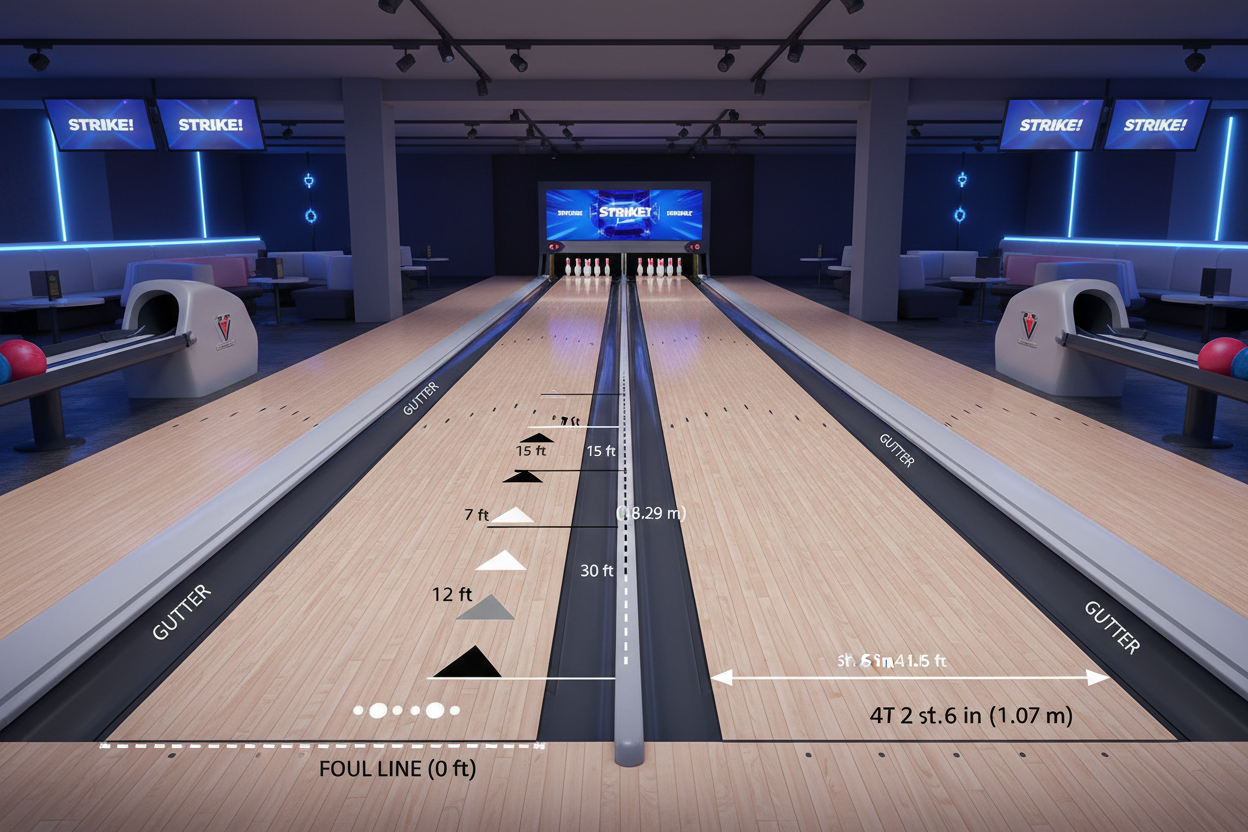

A bowling alley lane measures exactly 60 feet from the foul line to the headpin (pin 1), with the complete playing surface extending approximately 62 feet 10.3125 inches from foul line to the back of the pin deck. The USBC (United States Bowling Congress) mandates this precise 60-foot measurement as a cornerstone specification ensuring consistent gameplay across all sanctioned bowling facilities worldwide. Including the approach area where bowlers take their steps before releasing the ball, the total distance from the back of the approach to the headpin reaches approximately 75 feet. These standardized dimensions, unchanged for over a century, create the familiar bowling experience where ball speed, hook timing, and oil pattern interactions occur predictably across different facilities.

The regulation 60-foot measurement extends from the foul line—the boundary bowlers cannot cross during delivery—to the center of the headpin position. This distance provides the critical window where bowling balls develop their hook motion, transition from oil to dry backend, and ultimately impact the pins at optimal angles for strike potential. The measurement maintains strict tolerances of ±0.5 inches, ensuring competitive fairness where slight length variations wouldn't create significant advantages or disadvantages.
Beyond the 60-foot primary measurement, the pin deck (the area where pins sit) extends an additional 34.375 inches from the headpin center to the pit area where pins fall. Combined with the 2-inch distance from foul line to lane start, the complete playing surface spans 62 feet 10.3125 inches. The approach area behind the foul line adds approximately 15 feet, creating total distance from approach back to headpin of roughly 75 feet. These combined distances determine equipment requirements, facility layouts, and the physical space necessary for bowling lane construction.
The lane width measures 41.5 inches with 39 boards running lengthwise, each board approximately 1 inch wide. The boards provide the visual targeting system bowlers use for alignment and adjustment. Understanding what targets are in bowling helps contextualize how the 60-foot length relates to targeting arrows, dots, and boards. Bowlers wearing custom bowling jerseys in competition rely on these standardized dimensions for consistent shot execution.
|
Measurement |
Distance |
Purpose |
|
Foul line to headpin |
60 feet |
Primary playing distance |
|
Foul line to pin deck back |
62 feet 10.3125 inches |
Complete playing surface |
|
Approach area depth |
~15 feet |
Bowler approach space |
|
Total approach to headpin |
~75 feet |
Complete bowling area |
|
Lane width |
41.5 inches (39 boards) |
Standard lane width |
The 60-foot standard emerged in the late 19th and early 20th centuries as bowling organizations worked to standardize equipment and facility specifications across diverse regional variations. Prior to standardization, lane lengths varied significantly between 40-80 feet depending on facility, region, and local customs. The American Bowling Congress (ABC, predecessor to USBC) conducted extensive testing in the early 1900s to identify optimal length balancing skill requirements with achievability and entertainment value.
Testing determined that 60 feet provided sufficient distance for bowling balls to develop complex motion patterns—initial skid phase, transition/hook phase, and roll phase—creating strategic depth while remaining short enough that recreational bowlers could achieve reasonable success. Shorter lanes (40-50 feet) simplified gameplay to the point where strikes became too common and skill differentiation diminished. Longer lanes (70+ feet) proved excessively difficult, particularly with early equipment technology that offered limited hook potential compared to modern reactive resin balls.
The 60-foot standard was formally adopted in the early 1900s and has remained unchanged through over a century of bowling evolution. Even as ball technology advanced dramatically—from rubber balls to polyester to urethane to reactive resin—the fundamental 60-foot distance persisted as the constant against which all equipment innovations developed. This stability allowed bowling skills to transfer across decades and ensured facilities didn't require expensive renovations as equipment technology evolved. Understanding bowling's professional history provides context for how standardization efforts including lane length specifications shaped modern bowling.

The approach area spans approximately 15 feet from its back edge to the foul line, providing space for bowlers to execute their approach steps. Most bowlers use 4-5 step approaches requiring roughly 12-14 feet of distance, with the approach area designed to accommodate various approach lengths plus buffer space. The approach surface uses different materials than the lane proper—typically wood or synthetic materials with controlled friction characteristics allowing bowlers to slide on their final step without excessive resistance or slipperiness.
Approach dots located at 12 feet and 15 feet from the foul line help bowlers establish consistent starting positions. The dots align with specific boards allowing precise positioning that promotes repeatable targeting. The transition from approach to lane at the foul line represents a critical boundary—crossing this line during delivery results in foul, with no pins counting even if all ten fall. Professional bowlers in Storm bowling jerseys develop precise approach mechanics ensuring they release at the foul line without crossing. Equipment like the Storm Phaze AI bowling jersey performs optimally when released at proper position relative to the foul line.
The first 40-45 feet of lane from the foul line typically contains the oil pattern, though exact oil distance varies by pattern design. This oiled section allows bowling balls to skid with minimal friction, preserving energy while traveling toward the backend. The oil volume, length, and distribution pattern dramatically affect ball motion—heavy oil slows hook development, while lighter oil allows earlier ball reaction. Lane conditions create the strategic complexity separating elite bowlers from recreational players.
Modern lane conditioning machines apply oil with precise control, creating patterns ranging from simple "house shots" with heavy middle and dry outside boards to complex "sport patterns" with flat, challenging distributions. The 60-foot lane length provides the canvas for these patterns, with oil ending anywhere from 35-47 feet depending on pattern design. The distance from oil end to pins determines how much "dry lane" exists for the ball to develop aggressive hook motion. Understanding how to hook a bowling ball requires understanding how the 60-foot length relates to oil pattern interactions.

The final 15-20 feet of lane (approximately 40-45 feet from foul line to 60 feet) contains minimal or no oil, creating the high-friction "dry backend" where bowling balls generate most of their hook motion. Reactive resin coverstocks grip this dry surface aggressively, creating the sharp directional changes that allow balls to enter the pocket at optimal angles. This dry zone represents the critical region where ball selection, surface preparation, and release mechanics manifest as observable ball motion.
The backend's exact length varies by oil pattern—longer patterns (44-47 feet) create shorter backends requiring less aggressive balls or release adjustments to prevent over-reaction. Shorter patterns (35-40 feet) create longer backends where aggressive equipment can develop maximum hook without over-skating past the pocket. Competitive bowlers constantly monitor backend conditions as oil carrydown and friction changes alter ball motion throughout competition. Professional bowlers wearing Hammer bowling jerseys or Motiv bowling jerseys adjust their games based on backend length and transition characteristics.
The pin deck extends 34.375 inches beyond the 60-foot headpin measurement, providing the surface where pins stand arranged in their triangular formation. This area uses different construction than the lane proper—often harder wood or synthetic materials resistant to pin impact damage. The pin deck includes embedded sensors (in modern automatic facilities) that detect which pins fall, triggering the pinsetter machinery to clear fallen pins and reset standing pins for the next ball.
The 12-inch pin spacing combined with 15-inch pin height creates specific geometry determining how balls must approach the pocket for optimal strike potential. The 60-foot lane length positions pins at the exact distance where properly thrown balls develop their hook and arrive at correct angles. Changing lane length would alter these critical approach angles, requiring complete recalibration of targeting systems and potentially making the sport dramatically easier or harder depending on new dimensions.

The 60-foot distance creates optimal timing for ball motion phases across different bowling styles and equipment types. Slower-speed bowlers (14-16 mph) achieve full ball motion development—skid, hook, and roll—within the 60-foot window, allowing their balls to hook into the pocket effectively. Faster-speed bowlers (17-20 mph) also work within this distance, though their balls spend more time in skid phase and less in hook phase due to reduced friction time.
The length accommodates both straight ball bowlers and hook bowlers, providing sufficient distance for hook development without becoming so long that straight ball accuracy becomes impossibly difficult. This versatility ensures bowling remains accessible to diverse playing styles and skill levels—beginners can achieve reasonable success with straight balls while advanced players can deploy complex hooking techniques that exploit the full 60-foot motion window.
From a facility design perspective, 60 feet plus approach and pin deck areas creates manageable building requirements. Bowling centers can construct lanes within standard commercial building footprints without requiring extreme room lengths that would limit location options or dramatically increase construction costs. The dimension balances athletic requirements against practical real estate considerations, contributing to bowling's widespread availability compared to sports requiring substantially larger facilities.
Traditional bowling lanes use maple wood for the approach and approximately the first 12-15 feet of lane where balls impact with high frequency, plus pine for the remaining lane distance where impact occurs less frequently. Maple's greater density and durability resist the repeated ball impacts on the front section, while lighter, less expensive pine proves adequate for areas seeing primarily rolling contact. The pin deck uses highly durable materials (often maple or synthetic alternatives) withstanding continuous pin falls and sweeping machinery.

Modern bowling centers increasingly install synthetic lanes constructed from various proprietary materials designed to replicate wood performance while offering superior durability, consistency, and lower maintenance requirements. Synthetic lanes maintain more uniform characteristics across their surfaces compared to wood lanes where natural material variations create subtle performance differences. These synthetic surfaces resist warping from humidity and temperature changes that affect wood lanes, maintaining dimensional accuracy including the critical 60-foot length measurement.
Synthetic lanes cost more initially but reduce long-term maintenance expenses through superior durability and simpler care requirements. The consistent performance characteristics appeal to competitive bowlers seeking predictable conditions, while facility operators appreciate reduced maintenance labor. However, some traditional bowlers prefer wood lanes' aesthetic and subtle performance characteristics, creating market demand for both options. Tournament venues may specify wood or synthetic lanes in their rules, requiring competitors to adjust their games for each surface type. Professional equipment like the Hammer Black Widow Mania bowling jersey or Motiv Jackal Onyx bowling jersey performs on both surfaces, though optimal ball selection may vary.
The 60-foot distance determines oil pattern application strategies and maintenance scheduling. Lane conditioning machines traverse the 60-foot length applying precise oil volumes at specific distances, creating patterns that control ball motion. These machines must be programmed accounting for the exact 60-foot measurement to apply patterns accurately—errors of even a few inches could significantly alter intended pattern characteristics.
Daily lane maintenance involves cleaning the entire 60-foot surface to remove oil carrydown and debris, then reapplying fresh oil patterns. High-volume centers may complete this process 2-3 times daily, while lower-volume facilities might condition once daily or every other day. The maintenance window between conditioning affects play significantly—fresh patterns provide predictable hook points, while broken-down conditions after hours of play create unpredictable, challenging ball motion.
Competitive tournaments implement strict conditioning protocols ensuring all competitors face identical 60-foot conditions. Patterns are applied immediately before competition, then monitored throughout to verify they haven't degraded beyond acceptable tolerances. Pattern integrity over the 60-foot distance determines competition fairness—if one pair of lanes hooks differently than another due to conditioning variations, competitive equity suffers. Understanding how heavy bowling balls are relates to how ball weight affects lane surface interaction across the 60-foot distance.

While tenpin bowling uses the 60-foot standard, other bowling variations feature different lane lengths suited to their distinct gameplay characteristics.
Duckpin bowling uses lanes approximating tenpin specifications, typically 60 feet though some facilities use slightly shorter lanes (55-58 feet). The similarity in length allows some bowling centers to convert between tenpin and duckpin configurations. Candlepin bowling, popular in New England, also uses approximately 60-foot lanes with minor regional variations. These alternative formats maintain similar lane dimensions to tenpin bowling, facilitating shared facility use and reducing construction complexity for centers offering multiple bowling variations. Understanding duckpin bowling reveals how lane length similarities and differences affect gameplay across bowling variations.
Five-pin bowling, popular in Canada, uses lanes essentially identical to tenpin specifications—60 feet from foul line to headpin. The similar dimensions despite different pin count and arrangement demonstrate that 60 feet represents an optimal length applicable across multiple bowling format variations. The dimension's versatility explains its adoption across diverse bowling styles developed in different regions and eras.
The 60-foot lane length plus approach and pin deck areas requires approximately 85-90 feet of total room length for complete lane installation including buffer space beyond the pin deck for pinsetter machinery and maintenance access. Centers with 24 lanes thus need substantial building footprints accommodating parallel lane arrangements, approach areas, seating, concessions, and support facilities.
Standard bowling center layouts place lanes parallel to each other with minimal spacing between pairs. The long, narrow lane dimensions create distinctive facility geometries—bowling centers appear as elongated structures quite different from other recreational facility shapes. The 60-foot standard has influenced commercial real estate development patterns, with bowling-capable buildings requiring specific dimensional characteristics that limit location options and architectural flexibility.
Modern entertainment centers sometimes integrate shorter recreational "mini bowling" lanes (20-40 feet) for younger children or casual games, demonstrating that the 60-foot regulation length specifically serves competitive and traditional bowling. These alternative lengths provide accessibility for populations who might find regulation bowling challenging, while the 60-foot standard maintains competitive integrity for serious bowlers. Professional bowlers in Roto Grip bowling jerseys, 900 Global bowling jerseys, or Brunswick bowling jerseys compete exclusively on regulation 60-foot lanes.

The 60-foot distance relates directly to optimal ball speed ranges. Most bowlers throw 14-18 mph achieving roughly 3.5-4.5 second transit times from release to pin impact. This timing window allows proper ball motion phase development—initial skid (roughly 1.5-2.5 seconds / 30-40 feet), transition/hook (0.5-1.0 seconds / 10-15 feet), and roll into pins (0.5-1.0 seconds / 10-15 feet).
Extremely slow speeds (under 12 mph) risk balls losing momentum before completing the 60-foot distance, while excessive speeds (over 22 mph) may travel the distance before developing sufficient hook motion. The 60-foot length naturally constrains optimal speed ranges, creating self-regulating gameplay where speeds outside roughly 13-20 mph prove ineffective regardless of skill level. This natural constraint contributes to bowling's accessibility—there's a "Goldilocks zone" of effective speeds that most adults can achieve without extreme athletic capability. Understanding how to spin a bowling ball within the 60-foot framework creates optimal ball motion characteristics.
Modern laser measurement systems verify lane length accuracy during installation and periodic maintenance, ensuring the 60-foot specification remains within tolerances throughout lane lifespan. Wooden lanes can shrink or expand slightly with humidity changes, while synthetic lanes maintain more stable dimensions. Regular verification prevents gradual dimensional drift that could compromise competitive fairness or sanctioning compliance.
The USBC certification process includes comprehensive dimensional inspections verifying lane length, width, levelness, and surface conditions meet all specifications. Centers seeking USBC sanctioning must pass these inspections, with periodic recertification ensuring ongoing compliance. The rigorous standards ensure competitive bowling occurs on accurately specified equipment regardless of facility location or age, maintaining the sport's competitive integrity across thousands of sanctioned centers worldwide.
A bowling alley lane measures exactly 60 feet from the foul line to the headpin, with the complete playing surface extending approximately 62 feet 10.3125 inches to the back of the pin deck and total approach-to-pin distance reaching roughly 75 feet including the 15-foot approach area. This precise 60-foot standard, established over a century ago and maintained with strict tolerances of ±0.5 inches, creates the consistent framework where ball motion phases develop predictably across diverse bowling styles, equipment types, and facility locations worldwide. The distance balances skill requirements with accessibility, accommodates both recreational and competitive bowling, and influences facility design, maintenance protocols, and strategic gameplay elements that define modern tenpin bowling. By understanding how the 60-foot length relates to ball motion phases, oil pattern interactions, and targeting systems, bowlers develop deeper appreciation for the sport's technical complexity and the careful standardization that enables fair competition across thousands of bowling centers. Visit EFX to discover premium bowling apparel that complements your understanding of bowling's precisely engineered specifications and dimensions.
United States Bowling Congress. (2024). Lane specifications and dimensional requirements. USBC Rule Book, Chapter 4.
Professional Bowlers Association. (2024). Lane conditions and their impact on professional competition. PBA Facility Standards, Section 3.
Bowling Proprietors Association of America. (2024). Lane construction and maintenance guidelines. BPAA Technical Manual, 18(2), 45-67.
Miller, R. (2023). The evolution of bowling lane standardization and its impact on sport development. Journal of Bowling History, 31(4), 189-207.
