
May 27, 2026 11 min read
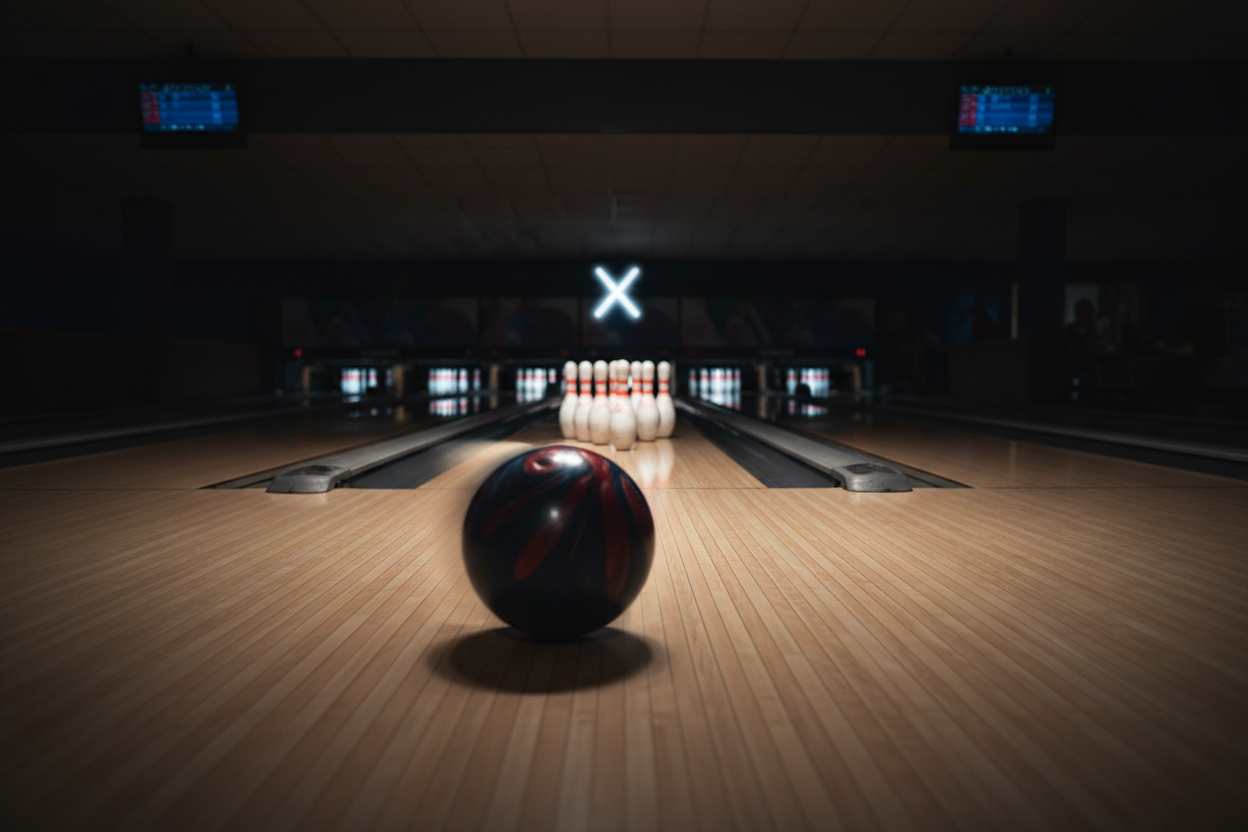
You hit a great shot, felt the release click, watched the ball curve into the pocket and still ended up with one pin standing. Bowling a strike every time is not realistic, but bowling strikes consistently absolutely is. The difference comes down to understanding why strikes happen, what goes wrong when they do not, and how to make the adjustments the pros use to get back on track.
Consistent strikes are not about throwing harder or adding more spin. They come from hitting a specific zone on the lane at a specific angle, repeatedly. Once you understand the geometry behind a strike, every adjustment you make becomes purposeful rather than guesswork.
To bowl a strike, you need to hit the pocket: the entry zone between the 1-pin and 3-pin for right-handed bowlers, or the 1-pin and 2-pin for left-handed bowlers. Getting the ball into that zone on the right board at the right angle is what produces the pin carry that results in a strike. Missing the pocket by even a couple of boards changes the pin deflection pattern and leaves pins standing.
When the ball enters the pocket correctly, it contacts the 1-pin at an angle that drives it into the 3-pin, which drives into the 6-pin and 10-pin. The 5-pin is taken out by the ball directly. This chain reaction is what clears all 10 pins. A ball that hits too high on the headpin deflects differently, leaving splits. A ball that hits too light on the outside of the pocket often leaves the corner pin standing because the chain reaction does not reach far enough.
The United States Bowling Congress has conducted extensive research into what makes a strike. Their data shows that when the center of the ball crosses the 17.5 board as it enters the pocket, bowlers strike 85 percent of the time and leave only a single-pin spare on the other 15 percent. Anything outside that window produces multi-pin leaves and splits at a much higher rate.
The optimal entry angle for maximizing pocket carry is six degrees. Most recreational bowlers achieve between three and four degrees. Every additional degree of entry angle meaningfully increases your strike percentage because it widens the effective pocket zone and improves pin deflection.
|
Pocket Entry Zone |
Board at Impact |
Expected Result |
|---|---|---|
|
Perfect pocket hit |
17.5 board |
Strike 85% / single pin 15% |
|
High hit (too far left for RH) |
14 to 16 board |
Headpin-heavy, splits common |
|
Light hit (too far right for RH) |
18 to 20 board |
Corner pin, weak carry |
|
Brooklyn (wrong pocket) |
Below 10 board |
Occasional strike, usually splits |
Hitting the 17.5 board consistently is the single most reliable target in bowling technique, and every adjustment you make should serve the goal of getting the ball to that entry point.
Every strike starts well before the ball reaches the pins. Your setup and footwork determine whether your release is in a position to hit the pocket, or whether you are compensating for mechanical problems by the time you reach the foul line.
The approach is not just transportation to the release point. It sets your timing, your balance, your arm swing path, and ultimately your accuracy. A clean, repeatable approach means the rest of your delivery can stay consistent frame after frame.
For a right-handed bowler using a four-step approach, start with your left foot just to the right of the center dot on the approach. This positions your body so that a natural swing and slide will put the ball over the second arrow from the right, which is the standard targeting reference for the strike line. If you hook the ball significantly, you may need to move further right to give the ball room to arc back into the pocket.
Take note of your exact starting position every time. Consistency in your starting spot is one of the easiest and most overlooked ways to improve shot-to-shot repeatability.

The four-step approach is the foundation of consistent bowling. Each step has a specific job, and understanding that job helps you identify what breaks down when shots go wrong.
|
Step |
Foot |
Arm Action |
Purpose |
|---|---|---|---|
|
Step 1 |
Dominant foot forward |
Pushaway: ball moves forward and down |
Sets swing path and timing |
|
Step 2 |
Non-dominant foot |
Ball swings back naturally |
Builds momentum |
|
Step 3 (Power step) |
Dominant foot |
Backswing reaches highest point |
Generates leverage |
|
Step 4 |
Non-dominant foot slides |
Ball swings through and releases |
Delivers the ball at the foul line |
The four-step approach works because each step coordinates your arm swing with your footwork, producing a timing pattern that your body can repeat through muscle memory.
The power step is the third step in a four-step approach, taken on your dominant foot. This step should have a noticeable bend in the knee, lowering your center of gravity and building the momentum that transfers into your slide and release. Bowlers who rush through the power step lose leverage and end up muscling the ball at the line instead of letting the swing do the work. A strong, deliberate power step is one of the clearest differences between a controlled delivery and an inconsistent one.
Most recreational bowlers look at the pins when they aim. It is the natural instinct, but it is the wrong target. The pins are 60 feet away, and trying to aim at something that far down the lane introduces error that compounds with every delivery. The arrows are your actual target, and using them correctly is one of the fastest improvements any bowler can make.
Aiming at the arrows instead of the pins brings your focus to a point roughly 15 feet past the foul line, where small adjustments have a much larger impact on accuracy. A ball that crosses the correct arrow with good speed and spin will follow its natural path into the pocket without needing further correction. A ball aimed at the pins requires perfect initial direction for 60 feet with no reference point to guide it.
For right-handed bowlers, the second arrow from the right (located on the 10th board) is the standard strike line targeting reference. Rolling your ball over this arrow from the correct starting position on the approach puts the ball on a path that, with a natural hook, angles into the 1-3 pocket at the entry zone needed for consistent carry.
Left-handed bowlers use the second arrow from the left (also the 10th board on their side) for the same reason. Most lane oil patterns are designed with a higher oil concentration in the middle of the lane, which is why starting on the outside and rolling over the second arrow gives the ball better traction and a more consistent arc toward the pocket.
Once you have a baseline with the second arrow, the dots on the approach and the boards on the lane surface become your precision tools. If your ball is consistently crossing the correct arrow but missing the pocket, the adjustment is in your starting position, not your target. Move your feet left or right in small increments (one to two boards at a time) while keeping your arrow target the same. This shifts your delivery line without disrupting your timing or release mechanics.

The release is where all your preparation either pays off or falls apart. Getting the ball into the pocket at the right angle requires not just accuracy but the right combination of speed, rotation, and follow-through.
A straight ball release, with your thumb pointing at 12 o'clock throughout the swing and release, produces minimal hook and a low entry angle of roughly two to three degrees. It is reliable for spare shooting and for beginner bowlers developing consistency, but it limits strike potential because the entry angle rarely reaches the six-degree ideal. Straight ball bowlers can still hit the pocket consistently; they just need to be more precise about board targeting since there is less margin for error.
A hook release rotates the fingers from the back of the ball to the side at the point of release, generating side rotation that causes the ball to arc toward the pocket rather than travel in a straight line. For a full breakdown of how to develop your hook technique, see How to Hook a Bowling Ball: Techniques and Tips.
This arc creates a steeper entry angle into the pocket. At four degrees of entry angle, your effective pocket zone is roughly two boards wide. At six degrees, it widens to nearly four boards, giving you significantly more margin for a strike even on slightly imperfect pocket hits. To generate hook, release the ball with your fingers at roughly the four to five o'clock position (for right-handers), rotating from behind to beside the ball as it leaves your hand.
Ball speed has a direct impact on hook potential and pin carry. The USBC and most coaching authorities identify 16 to 19 mph as the optimal range for consistent strikes. Below 16 mph, the ball hooks too early and loses the backend energy needed for strong pin action. Above 19 mph, the ball does not have enough time to hook into the pocket, reducing entry angle and weakening pin carry even on accurate shots.
Most bowlers can check ball speed using the scoring system displays at most modern alleys. If you are regularly outside the 16 to 19 mph window, small adjustments to your pushaway timing or follow-through length are usually enough to correct it.
After releasing the ball, your arm should continue in the pendulum motion until your hand is above your shoulder. A truncated follow-through reduces the rotation applied to the ball at the moment of release and shifts the ball path offline. Bowlers who stop their arm swing early often wonder why their ball consistently drifts the same direction even when the approach and targeting feel correct. The follow-through is the last mechanical action that affects the ball, and cutting it short costs accuracy and consistency on every single shot.
|
Release Type |
Hook Generated |
Approx. Entry Angle |
Strike Potential |
|---|---|---|---|
|
Straight (thumb at 12 o'clock) |
Minimal |
2 to 3 degrees |
Moderate, low margin |
|
Mild hook (fingers at 4-5 o'clock) |
Moderate |
3 to 5 degrees |
Good |
|
Strong hook (aggressive finger rotation) |
High |
5 to 6+ degrees |
High, requires lane reading |
The release type that produces the best results depends on your current skill level and the lane conditions you are playing on, not on what looks most impressive.
Even with good technique, shots miss. Lane conditions change, timing drifts, and oil patterns break down over the course of a session. The ability to make fast, accurate adjustments is what separates a bowler who strings strikes from one who throws an occasional good shot surrounded by misses.
When your ball is missing the pocket consistently in the same direction, the instinct is to change where you aim. The correct adjustment is to move your feet. Keep your arrow target the same and move your starting position one or two boards in the direction of your miss. If you are hitting left of the pocket, move your feet left. If you are hitting right, move right. This shifts your entire delivery line while keeping your timing and arm swing mechanics intact.
Changing your arrow target instead of your feet disrupts the relationship between your starting position, swing path, and release point, introducing new variables that make consistent corrections harder to find.
For right-handed bowlers, a ball that consistently hits left of the pocket (too high on the headpin) usually means you are releasing the ball too early or your starting position is too far left. Moving your feet two boards to the right while keeping the same arrow target shifts the ball path right without altering your mechanics. A ball that hits right of the pocket (too light, leaving the corner pin) means the opposite: move your feet two boards left.

The pins you leave standing after a pocket hit give you specific information about what went wrong. A solid pocket hit that leaves the 10-pin (for right-handers) typically means the ball hit slightly high, carrying the 6-pin away from the 10-pin rather than driving through it. A 7-pin leave after what felt like a pocket hit usually means the ball deflected too much, suggesting the entry angle was too shallow.
|
Miss Pattern |
Likely Cause |
Adjustment |
|---|---|---|
|
High hit, leaving splits |
Ball too far left, entry angle too flat |
Move feet 2 boards right |
|
Light hit, 10-pin leave |
Ball too far right, missed pocket outside |
Move feet 2 boards left |
|
Consistent Brooklyn |
Overcorrected, starting too far right |
Move feet 2 boards left |
|
Good pocket hit, leaving 10-pin |
Shallow entry angle, high hit |
Add more hook or move further right |
|
Ringing 7-pin |
Ball deflected on high hit |
Move feet right and check speed |
These adjustments are starting points. On lanes with heavy oil or unusual patterns, larger moves may be needed, but the direction of each adjustment remains the same.
Learning how to bowl a strike is one thing. Doing it consistently across a full game, a full session, and an entire league season is a different challenge entirely. Consistency comes from repetition with awareness, not just volume.
Your body learns bowling through repetition of correct mechanics. Understanding what score range you are targeting at your skill level helps you measure whether your strike work is translating to real game improvement.
See more: What Is a Good Bowling Score: Understanding Averages, Skill Levels and Age Comparisons
After roughly 200 to 300 quality deliveries using the same stance, approach, and release, the pattern starts to become automatic. The goal of practice is not to throw as many balls as possible but to execute the same correct motion as many times as possible. One focused session on a specific adjustment produces more lasting improvement than three sessions of unfocused rolling.
Oil patterns on bowling lanes break down over the course of a session as balls absorb oil and carry it down the lane. Early in a session, lanes tend to be more heavily oiled, causing balls to slide further before hooking. As the session progresses, the front of the lane dries out and balls hook earlier. Bowlers who recognize this transition and move their feet slightly toward the center (for right-handers, moving left) are able to maintain pocket entry as conditions shift.
See more: 10 Pro Bowling Tips That Instantly Improve Your Game from Our Sponsored Athletes
Bowling the same lanes week after week in a league forces you to develop lane-reading skills that casual sessions cannot replicate. You learn how the oil pattern on your pair behaves at different points in the session, which adjustments work on that particular surface, and how to execute under competitive pressure when a strike matters for the team's score.
Bowlers who join leagues consistently improve their averages faster than those who bowl casually, because the structured format creates accountability for every shot. Teams that compete seriously also invest in the details that build consistency, from pre-game routines to matching bowling team jerseys that create a unified identity on the lanes.
See more: Bowling Tips for Beginners: Master the Basics and Hit More Strikes

Consistent strikes come down to three things: hitting the pocket at the right board and angle, clean mechanics through your approach and release, and adjusting your feet when shots drift. Master the 17.5 board, build a repeatable four-step approach, and trust the process. Ready to look the part? Explore our custom bowling jerseys built for players who take the game seriously.