
May 27, 2026 7 min read
Your shots are inconsistent and you cannot figure out why. Grip feels fine, target looks right, but the ball ends up somewhere different every time. Nine times out of ten, the problem is not your release. It is your feet. The 4-step bowling approach is the engine behind every consistent delivery. This guide breaks down each step, what goes wrong, and exactly how to fix it.
The 4-step bowling approach is a four-stride walk from your starting position to the foul line, synchronized with your arm swing to deliver the ball at the precise moment your momentum peaks. Each step has a specific job: when they work together, your arm swing becomes free and natural, your body arrives at the foul line in balance, and the ball releases exactly when it should. When one step is off, every step after it compounds the problem.
The mechanics are built around momentum. Walking generates forward energy, and that energy transfers into ball speed at the release point. You are not lifting or pushing the ball. You are letting gravity do the work while your footwork keeps everything timed. Most bowlers who feel like they are muscling the ball have a footwork timing problem. Fix the feet, and the arm swing sorts itself out.
Neither is superior. The choice comes down to your natural walking rhythm and body mechanics.
|
4-Step Approach |
5-Step Approach |
|
|---|---|---|
|
First step |
Ball-side foot (right for right-handers) |
Non-ball-side foot (left for right-handers) |
|
Total steps |
4 |
5 |
|
Timing feel |
More compact, faster tempo |
More gradual, smoother build |
|
Best for |
Bowlers with faster natural tempo |
Bowlers who need extra time to get the swing moving |
|
Common at |
Beginner through advanced |
Common among PBA pros |
If your natural walking pace is quick, the 4-step approach likely matches your rhythm better. If you feel rushed on a 4-step, try the 5-step by adding one small step with your non-ball-side foot at the start.
Your starting position determines your distance from the foul line and your lateral alignment to your target. Get this wrong and no amount of good technique saves the shot.

Turn your back to the pins, place your heels on the foul line, and walk four and a half normal strides away from the line. Turn around. That is your starting position distance for a 4-step approach. The half step accounts for the slide you make on your final step, which carries you slightly past where your last full step lands.
Everyone's stride length is different, so this measurement is personal. Once you find the distance that consistently brings you to the foul line without stepping over it, mark it using the approach dots behind the foul line.
Stand with your non-ball-side foot aligned with the center dot (board 20) on the approach. For right-handed bowlers, that is your left foot over the middle dot. This gives you a neutral starting position that works with the standard second-arrow targeting line on house shot oil patterns. For a full explanation of what the arrows, dots, and targets on the lane actually are, see What Are the Targets in Bowling Called.
Your lateral position shifts as you develop your game, but center dot as your default left-foot anchor is a reliable starting point.
Ball height affects your timing directly. Hold the ball too low and your swing starts late. Hold it too high and it rushes ahead of your feet. Match ball height to your tempo: fast walker, hold lower (thigh to waist); slower walker, hold at waist or slightly above. Most bowlers default to waist height and that works fine as a starting point.
Here is each step in sequence: what your feet are doing, what your arm is doing, and the goal of that step.
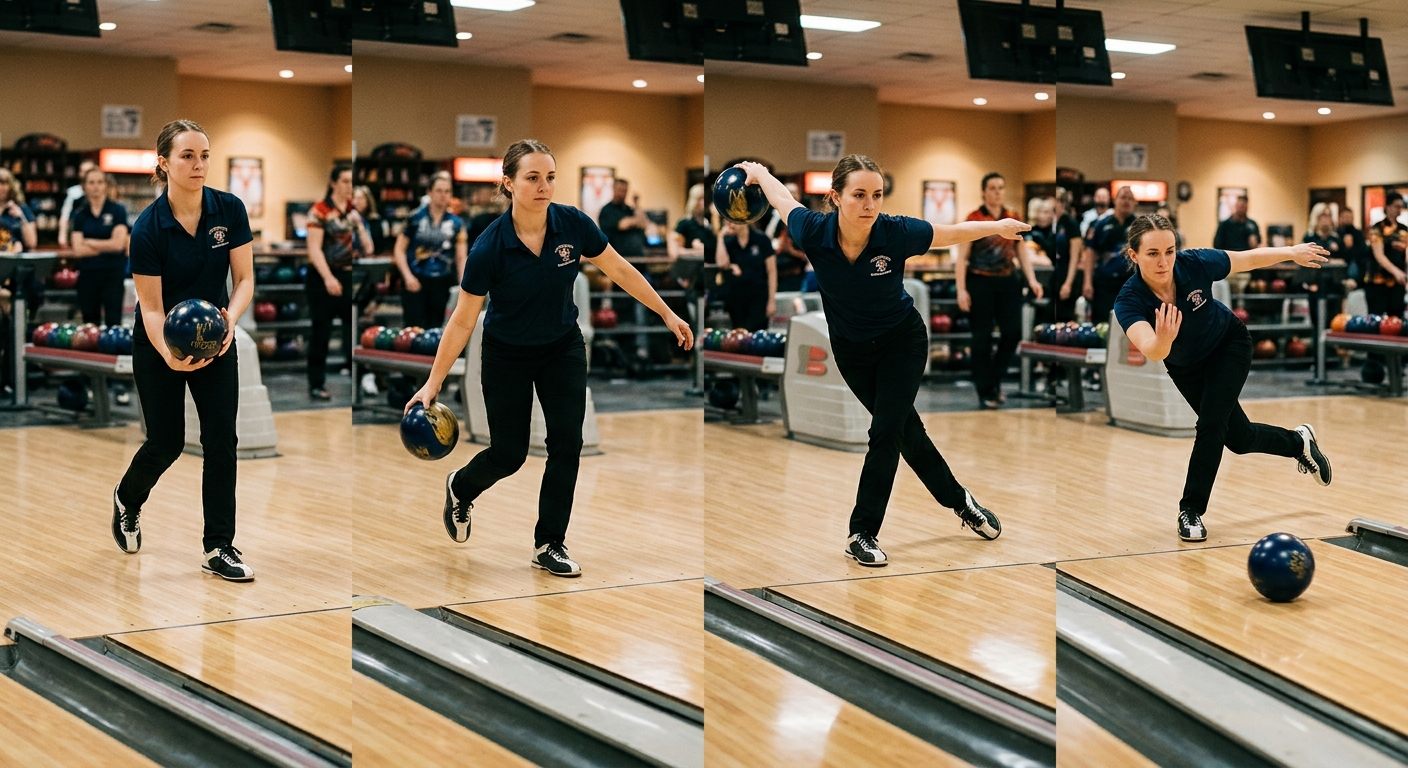
Your right foot steps forward as your arm simultaneously pushes the ball out and slightly downward. The ball should leave your body in a smooth, rounded motion, not a shove, and start its descent toward the downswing. Start the pushaway the exact moment your right foot lifts. A late pushaway means the ball never reaches proper swing position, forcing you to muscle it through the rest of the approach.
Your left foot steps forward as the ball swings down past your leg and begins the backswing. Let gravity do the work. Do not guide or control the ball's path. Your non-bowling arm extends slightly for balance, and your shoulder stays square to your target line.
Your right foot takes a longer stride with a deliberate bend in the knee. This is the most important step. As it plants, the ball should be at the top of its backswing. The knee bend lowers your center of gravity and loads the energy that transfers into your slide and release. Bowlers who skip a proper power step arrive at the foul line upright, losing leverage and ball speed.
Your left foot slides forward as the ball swings through the bottom of its arc. The slide absorbs your momentum and stabilizes your body. When your slide foot stops, your bowling hand should be passing your ankle at the bottom of the swing, that is your release point. Do not plant your left foot. Slide into it. A planted foot jolts your body and throws the release off-line.
|
Step |
Foot |
Arm Action |
Key Feel |
|---|---|---|---|
|
1: Pushaway |
Right forward |
Ball pushes out and down |
Ball leaves body smoothly |
|
2: Downswing |
Left forward |
Ball swings down naturally |
No muscling, pendulum only |
|
3: Power step |
Right forward (longer, bent knee) |
Ball at top of backswing |
Energy loaded, body lowered |
|
4: Slide and release |
Left foot slides |
Ball swings through, releases at ankle |
Stable base, natural exit |
Every step feeds into the next. When all four connect, the delivery feels almost effortless.

Perfect footwork means nothing if your arm swing is out of sync. Timing connects the two, and getting it right is the difference between a delivery that repeats and one that feels different every frame.
Think of your arm swing and your footwork as two gears that need to turn at the same speed. Your steps set the tempo, and your swing must match it. The key timing checkpoint is step 3: when your right foot plants on the power step, the ball must be at the peak of the backswing, not before, not after. Ball reaches the top before step 3? Early timing, and you will hesitate. Ball still rising during step 4? Late timing, and you will muscle through. When timing is right, the approach feels smooth and continuous, and the delivery almost takes care of itself.
Before changing your steps or pushaway mechanics, try adjusting ball height. It is the simplest timing fix available. Lower ball height shortens the swing arc and speeds up timing. Higher ball height lengthens it and slows timing down.
|
Timing Issue |
Symptom |
Adjustment |
|---|---|---|
|
Early timing |
Ball waits at top; you hesitate mid-approach |
Lower ball height; slow down pushaway |
|
Late timing |
Ball still rising as you slide; forced delivery |
Raise ball height; initiate pushaway earlier |
|
Good timing |
Smooth, continuous, effortless feel |
Maintain current ball height and tempo |
Ball height is always the first adjustment to try before touching anything else in your footwork.
See more: How to Hook a Bowling Ball: Techniques and Tips
Most approach problems trace to four recurring errors. Each one has a specific cause and a specific fix.
|
Mistake |
What It Looks Like |
Root Cause |
Fix |
|---|---|---|---|
|
Rushing |
Shots feel out of control, inconsistent direction |
First step too fast |
Slow step 1 deliberately |
|
Late pushaway |
Arm swing behind feet all approach |
Ball starts moving after step 1 |
Sync pushaway with step 1 lift |
|
No balance at finish |
Falling forward or sideways at release |
Shallow knee bend; planted slide |
Bend deeper on step 3; slide, do not plant |
|
Drifting |
Ball ends up well off target despite correct aim |
Steps angling sideways |
Use a board or tape line as a guide |
Most mistakes compound each other. Fix the earliest error first, since it is usually causing everything downstream.
Targeted drills isolate specific parts of the delivery and accelerate improvement faster than casual play.
Stand one step away from the foul line, take only your slide step, and release the ball. This isolates release timing and balance without the full approach complexity. Start every practice session with 10 to 15 of these before adding steps back in.
Walk your full approach without holding a ball. With nothing in your hand, it is easier to feel what your feet are actually doing. Most bowlers discover drift or timing issues during shadow bowling that they never noticed while focused on the shot.
After each delivery, check which board your slide foot landed on. Consistent board means a repeatable approach. Scattered results tell you one step is breaking down, then you work backward to find which one.
See more: 10 Pro Bowling Tips That Instantly Improve Your Game from Our Sponsored Athletes

Practice builds mechanics. League builds the mental repetition to execute them under pressure. A 4-step approach that repeats reliably in casual bowling needs one more thing to hold up in competition: a pre-shot routine.
In league play, the bowler who can repeat the same approach and adjust their starting position while keeping mechanics intact will outscore the harder but inconsistent thrower every session. Your approach is also your reset mechanism between shots. After a bad frame, it is the reliable thing you return to.
Build a pre-shot routine: same ball pickup, same start dot position, same breath and line visualization before every delivery. When a shot goes wrong, go back to your routine and let two or three shots of data tell you whether an adjustment is needed before changing anything.
Bowlers who take league seriously invest in the details that build team consistency, including custom bowling jerseys that signal every player is approaching the game at the same level.
See more: Bowling Tips for Beginners: Master the Basics and Hit More Strikes
The 4-step approach is the foundation every consistent bowler builds on. Get your starting position right, sync your pushaway with step 1, load through the power step, and slide into a balanced finish. Master those four and your release has a stable platform to work from. Ready to look the part? Browse our bowling team jerseys built for league play.